






I have sourdough starter. Now what?
How to feed and grow sourdough starter, and how to bake with it.

Date
November 8, 2021


Love sourdough, but looking for a bit more flexibility and ease when you bake with a starter? In The Casual Sourdough Baker, PJ shows you just how wonderfully stress-free sourdough baking can be, from simple but richly flavored loaves to countless easy ways to use your discard. If you're just beginning your journey, our Sourdough Baking Guide lays out the basics you need for success — whether you decide to become serious or go casual! Today's topic: What to do with sourdough starter.
* * *
Someone just gifted you with some of their sourdough starter. Or you’ve decided to buy one from King Arthur. Alright, sourdough bread here we come!
Then you realize there’s still that gray area between receiving your new starter and actually using it to make bread. Dealing with starter for the first time is kind of like bringing a newborn baby home from the hospital. You’ve read all the books and thought you were ready, but now that the baby is actually here, what do you do?!
First, relax. Your “baby” is going to be fine. Like all babies, your sourdough starter requires warmth, food, and attention. But unlike human infants, whose needs are pretty much nonstop, your starter needs very little attention; once you feed it, it can sleep happily in the back of your fridge for days (even weeks) at a time.
Here are the steps you need to take:
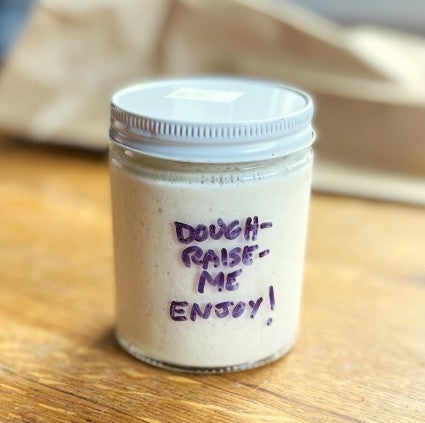
Let's assume your friend has gifted you starter in storage mode (i.e., not having been fed over the past 24 hours). Like a baby, you need to first feed your new starter, then let it rest in a comfy spot. Here’s what to do.
Take a scant 1/4 cup (50g) of the sourdough starter (discarding any additional starter) and place it in a medium-sized bowl: stoneware, glass, plastic, doesn’t matter what it’s made of (though if you use metal, be sure it’s stainless steel).
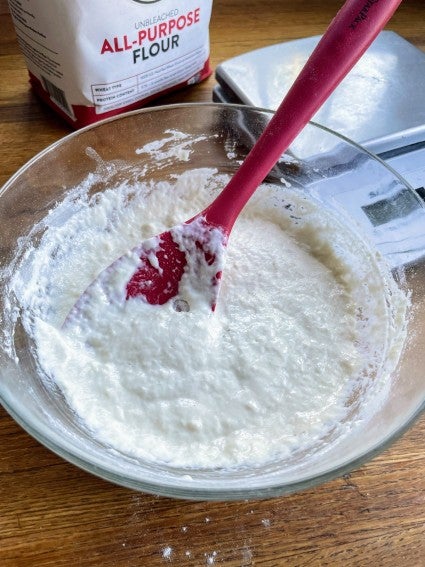
Add a scant 1/4 cup (50g) lukewarm water (tap water is fine) and about 6 tablespoons (50g) unbleached all-purpose flour. Stir until everything is well combined.
Cover the bowl; it shouldn’t be completely airtight but you also don’t want the starter drying out, so a kitchen towel isn’t suitable. Try a reusable bowl cover or plastic wrap.
Place the bowl in a moderately warm spot, somewhere between 68°F and 78°F. Options: Heat your microwave for 1 minute (to about 80°F), then place the bowl inside. Or place the bowl in your turned-off oven with the oven light on. Like a baby, your starter wants to be cozy, neither super-warm nor shiveringly cold.
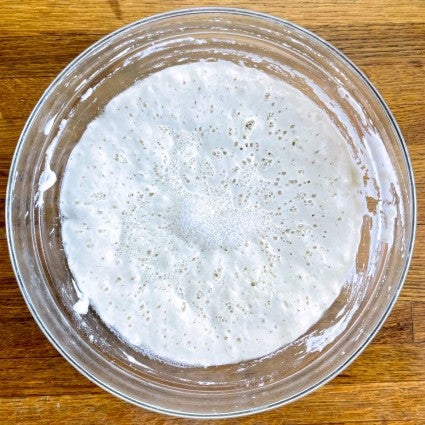
After 8 hours (wouldn’t you love your new baby to sleep for 8 hours at a time?!), take a peek at the starter. Has it become bubbly and doubled in size? If so, great; it's ready to stash in the fridge or use in a recipe. If not, you'll want to feed it again.
Give your starter another meal: Scoop out 50g of starter (discard the rest), place it in a bowl, feed it with 50g each unbleached all-purpose flour and lukewarm water, keep it warm, and wait 8 hours or so for it to grow.
If after its second feeding it hasn't doubled in size within 8 hours, don't give up; your new starter just may need some extra TLC. Continue feeding as directed above. In order to keep your schedule sane, move to feeding just once a day.
See full directions on how to feed sourdough starter here: Feeding and Maintaining Your Sourdough Starter
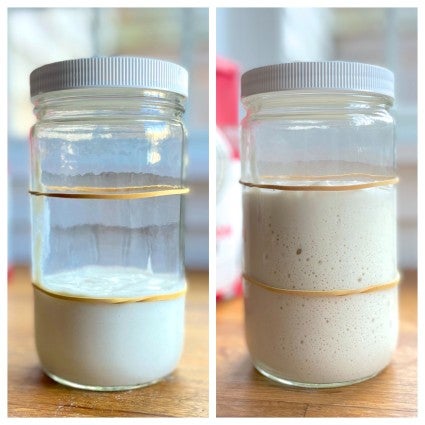
You can leave your fed starter in the bowl during this process, or do as I do: Transfer it to a 32-ounce straight-sided glass jar, such as a wide-mouth quart-sized canning jar. Loop a rubber band around the jar at the height of the starter, then measure how tall the starter will be when it’s doubled and loop another rubber band there. When it reaches the second rubber band it’s doubled in size.
Once your starter is reliably doubling in size within 8 hours of being fed, it's ready to bake with — or store for future use. If you plan on refrigerating your fed starter, let it rest at room temperature for 2 hours after its feeding before stashing it in the fridge.
If after three to four days of feeding your starter doesn’t double within 8 hours of being fed, I’d recommend ditching it and buying a vital, healthy starter from King Arthur.
As always, King Arthur does everything possible to guarantee your success: Just follow the feeding directions in the booklet that comes with the little jar of live starter you purchased, and your new baby will start to grow within hours — and grow, and grow!
If you haven’t yet bought your starter, here’s a preview of what you’ll do once it arrives. Basically, just feed it with water and flour according to the instructions in the booklet, then let it rest, undisturbed, for anywhere from 8 to 24 hours; the warmer your kitchen, the more quickly your starter will grow.
Keep feeding regularly until your starter is ready to bake. Your starter is ready to use in a recipe once it reliably doubles in volume about 6 to 8 hours after feeding.
See full directions on how to feed sourdough starter here: Feeding and Maintaining Your Sourdough Starter
Once your starter is regularly doubling in volume 6 to 8 hours after feeding, it's healthy and active enough to bake with!
If your recipe calls for "unfed" or "discard" starter, you don't have to do anything special to ready it for baking — just transfer straight from the jar to your recipe.
If your recipe calls for "ripe" or "fed" sourdough starter, that means you want to use starter about 6 to 8 hours after being fed. At this point, your sourdough starter should be doubled or tripled in volume after a recent feeding and then slowed down in activity. Learn more: Ripe sourdough starter: Here's what that means.
And if your recipe calls for more ripe sourdough starter than you have in your jar, here's how to build the exact amount of ripe sourdough starter for a recipe.
Finally, what about all that extra starter you’re supposed to discard along the way? Despite its name, you can save and use it in all kinds of recipes, from biscuits and pancakes to crackers and cake. Check out our sourdough discard recipe collection for inspiration. And if you’re uncomfortable with the amount of discard you’re generating, there’s a simple solution: reduce the size of your starter. See our instructions for maintaining a smaller sourdough starter.
Cover photo by Kristin Teig.