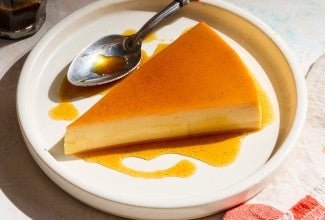



An expert's tips to nail your flan
For stunning, silky-smooth flan, follow these pro tips.


This piece is a lightly adapted excerpt from Mia Castro’s new cookbook, Cocina Puerto Rico.
When I think of Puerto Rican desserts, the first that comes to mind is flan — a richer, more flavorful cousin of the classic French crème caramel. It’s a delicate custard made with evaporated milk, condensed milk, and eggs, gently baked in a caramel-coated pan inside a steamy water bath.
Flans are a foundational dessert in Puerto Rican gastronomy and are notoriously tricky — even my abuela won’t make them because she’s had too many go sideways. After making more flans than I can count (and messing up a fair share), I developed this failproof recipe for Vanilla Bean Flan; here are some troubleshooting tips that will help ensure your flan turns out perfectly, too.
I use the “wet” method (adding water to sugar) to make my caramel, which gives more control and helps prevent burning. To make it this way, gently pour the water around the sugar, then shimmy the pot to hydrate it evenly — avoid stirring and splashing, which can cause sugar crystals to stick to the sides of the pan, resulting in a grainy caramel.
Cook the mixture over medium heat, and keep a close eye on the pan. Only stir if you notice the caramel is browning unevenly. If clumps form or the sugar crystals aren't dissolving, lower the heat and press on the clumps or crystal with the back of a heatproof spatula until they disappear.
I’m stating the obvious, but caramel is HOT, so don’t get any ideas about tasting it in its liquid state. You’ll sear your tongue — speaking from experience here.
The color is up to you: Caramel cooked to a light golden color is milder, while caramel cooked to a darker amber color has a more robust flavor. I like mine deep golden. You can test the color by dropping a few drops onto a white plate. As soon as you achieve your desired shade, quickly pour the caramel into your baking pan and, using oven mitts, rotate the pan immediately to coat the bottom and some of the sides before it hardens.
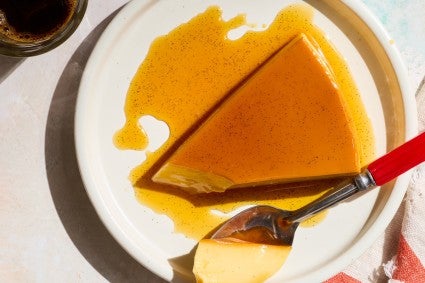
For a smooth, creamy flan texture, take care when you combine the ingredients. If you overbeat the mixture of milk, sugar, and dairy, you can add air, which can lead to bubbles and a flan with a spongy surface. To avoid this pitfall, blend the dairy ingredients first until smooth, then add the eggs and blend briefly. Always skim any foam off the top to avoid bubbles in the cooked flan, and strain the custard through a fine-mesh sieve — don’t press anything through.
You also want to nail the timing of your cooking to ensure a silky flan. Undercooking results in a runny custard that won’t hold its shape when unmolded, while overcooking results in a firm, eggy custard filled with holes throughout.
Remove your flan from the oven when it’s set around the edges but still has a soft jiggle in the center, like Jell-O. To check, gently shimmy the pan — if the edges are set but the center wobbles slightly, it’s ready. Take it out at that point — it will continue to cook as it cools. Let it sit in the water bath until the water is room temperature, then discard the water bath and transfer the flan to the fridge to chill until fully set, at least 6 hours but preferably overnight.
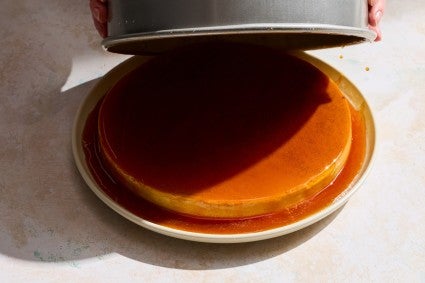
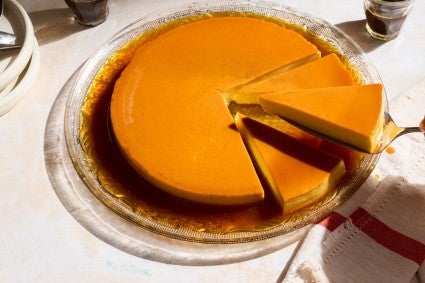
The final step! I recommend that you unmold your flan just before serving. To unmold, run a thin knife around the edges, then dip the bottom of the pan in a larger dish filled with warm water (the one you used for your water bath is a good choice!) for 10 to 15 seconds to loosen the caramel. If you hear a crack, don’t panic — it’s just hard caramel. Invert a rimmed plate over the pan. With one hand on the plate and the other under the pan, flip it swiftly and confidently. The flan should gently unmold onto the serving plate. If it sticks, gently press on the pan or slide a knife in slightly to break the air seal.
If you’re taking your flan to a dinner party, the best way to transport it is in its pan. Keep it chilled until dessert time, then turn out of the pan just before serving.
Want more flan in your life? Try this magical chocoflan.
Cover photo by Patrick Marinello; food styling by Yekaterina Boytsova.