



How to turn any bread dough into rolls
Transform your favorite bread loaf into shareable rolls.

Date
November 16, 2026


So you have a beloved bread recipe that you'd like to turn into fluffy, single-serving rolls, but you don’t know where to start. We’re here to help — let’s get rolling!
Rolls are basically just tiny bread. Which means that, yes, you can technically make a pan of rolls out of any bread dough.
But first, consider the recipe and what type of rolls you're looking to make. If you want soft, fluffy pull-apart rolls (typically baked nestled together in a pan), consider starting with an enriched dough like brioche, milk bread, or challah. If you want crusty, European-style rolls (often baked on sheet trays), start with a leaner dough, such as this pain au levain.
Essentially, the type of bread you start with will determine the type of rolls you make, so plan accordingly.
Turning a bread recipe into rolls is simple: After the dough has had its first rise (otherwise known as its bulk ferment), divide it into small pieces, shape them into rolls, give them a final rise, and bake. The good news is that you don’t need to make any changes to the recipe itself — simply prepare the dough as written and leave it to undergo its first rise.

Once the bread dough has risen, it's time to divide it. Consider: How many rolls do you want, and how large do you want them to be?
Your best bet for even-sized rolls is to grab a calculator and kitchen scale. While you could divide your dough by eye, it’s faster, easier, and more accurate to use the weight measurements, if possible.
For size reference, the pre-bake weight of dinner rolls typically falls between 60g to 80g each. Imagine a 60g roll as the size of a plum when baked, while a baked 80g roll is closer to a Granny Smith apple. Moving up in the ranks are burger buns, which weigh around 100g or so pre-bake.
Here's how much each rolls should weigh before baking:
If you want small-to-medium dinner rolls: 60g to 70g
If you want medium-to-large dinner rolls: 80g to 90g
If you want extra-large dinner rolls or burger buns: 100g to 110g
Let’s say you’re using our Back-of-the-Bag Oatmeal Bread recipe. The total weight of the dough is about 830g. If your first thought is, “I want eight rolls!” you’re going to wind up with eight oat-y burger bun-sized rolls, because 830g divided by eight is just over 100g per roll. That's likely too large if you're looking to make standard dinner rolls.
To ensure you get properly sized rolls, it’s easiest to start by dividing the total weight of the dough by the weight of the size you want your rolls to be, rather than the number of rolls you want. In this case, 830g ÷ 75g = 11 large dinner rolls.
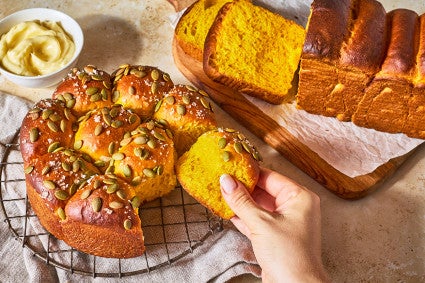
Once divided, it's time to shape the pieces of bread dough. If you’ve never shaped dinner rolls, have no fear! We have you covered, no matter the shape you choose. Basic round rolls? Got it. Fancy shapes? Yep. Braided rolls? You bet. And so much more. Often it helps to see the process in action, especially when it comes to hand positioning when shaping rolls.
For gluten-free breads, scoop the “dough” into a greased muffin pan rather than attempt to shape rolls by hand, since the dough is more like batter. If you're making medium or large gluten-free rolls, check out our Gluten-Free Dinner Rolls recipe for more details.
Small rolls won’t take as long to bake as a loaf would. Most will take around 20 to 30 minutes to bake, depending on their size. You can usually stick with the temperature your original recipe calls for, but 350°F is a safe bet, too.
A final note: Rolls baked close together in "pull-apart" style will usually take a bit longer to bake than they would if they were spaced out on a baking sheet.
And remember, if you make more rolls than you can eat in one sitting, you can always freeze and bake them.
We're diving deep on rolls ahead of Thanksgiving in our latest podcast episode, all about rolls.
Cover photo by Patrick Marinello; food styling by Kaitlin Wayne.
Editor's note: This blog was originally published in 2021, and we've updated it and republished in November 2026.
