

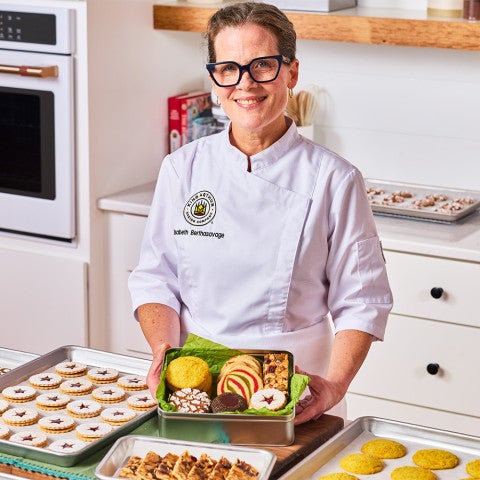



Thanksgiving is All About the Rolls, with Martin Philip
Thanksgiving is just around the corner, which means it’s time to talk about the best part of the holiday: the rolls!
David and Jessica dive into some of the history of the breadbasket and the tradition of eating bread alongside a meal, then Jessica sits down with King Arthur’s Martin Philip, a bread expert who shares his best tips and strategies for great Thanksgiving rolls. Jessica and David answer your call-in questions, including strategies for making rolls ahead of time, and to close out the show, they discuss a controversial Jess-opinion and share the recipes they’re baking this week.
- Find our go-to potato roll recipe in The Big Book of Bread
- Learn more bread-baking skills from Martin in his On-Demand Baking Class
- Read about steaming bread in a gas oven
- Check out some of our go-to roll recipes: Amish Potato Rolls, Japanese Milk Bread Rolls, Big Batch Quick Dinner Rolls, Parker House Rolls
- Get more info on our Bake for Good program
- Bake our recipe for Make-Ahead Brown and Serve Rolls
- What David’s baking this week: Samosa Knish
- What Jessica’s baking this week: Buffalo Rolls from The Big Book of Bread
- Record your question for our Ask the Bakers segment here!
- Follow along with us on Substack
- For 25% off any On-Demand baking class, use coupon code POD25 at shop.kingarthurbaking.com/on-demand-classes
- This episode is sponsored by Brød & Taylor. Your best bread is within reach. Brød & Taylor builds tools that help you get there. See what's possible at brodandtaylor.com.
- This episode is sponsored by Red Star. Red Star has a yeast for every kind of baker. Visit redstaryeast.com to find a retail store near you or purchase their full line of products online.
Episode Transcript
- I can hate what I hate.
- Exactly. You can hate what you hate. And on that note, everyone, have a great Thanksgiving.
- From King Arthur Baking Company, this is "Things Bakers Know." I'm Jessica Battilana, employee-owner at King Arthur.
- And I'm David Tamarkin, also an employee-owner at King Arthur. And today, we're talking about bread.
- Woo!
- Not just any bread, Jessica.
- Ooh, okay.
- Specifically, we are talking about rolls.
- I love a dinner roll.
- Me too.
- I mean, the rolls, it's the time of year we're all thinking about Thanksgiving, planning for Thanksgiving. And I would even go so far as to say a roll might be my favorite part of Thanksgiving.
- That's a little crazy.
- I like-
- Roll versus pie?
- Well, I like the pies. I love the pies.
- We're gonna roll over for rolls?
- Right, like... But I think a fluffy dinner roll is a very important part of a holiday meal or a special meal, like a celebratory meal. And, frankly, you blew my mind the other day 'cause you told me that you never have rolls at Thanksgiving.
- Well, first of all, that's libel. Libel? Is that the right term? That is not true.
- Oh?
- I think I said I used to, used to not have any. And then I am slowly incorporating it. It is new to our family, new to our Thanksgiving repertoire.
- Oh, wow.
- But now, I mean, you do it once, you can't take it away.
- Well, no, 'cause they're so great. I mean, what you said was, like, that the starchy carb hole was filled by mashed potatoes.
- Well, not just mashed potatoes. It's like the mashed potatoes, the sweet potatoes, the stuffing-
- Sure.
- And then I was like, "I'm gonna add rolls to this," but I did.
- I mean, this is the thing. Like, do you ever need a roll? Is it want, not a need?
- I don't know. I mean, you said you called it a dinner roll, and I just wanna say I'm here to free the roll from dinner.
- Okay.
- Because when I need a roll most, perhaps with lunch-
- Okay.
- With my salad or my soup, like a lunch roll.
- Well, you know, the nice thing, I was thinking about this, and yes, it's true. There are already a lot of, like, starchy, carby things. But actually one of the best ways to make, like, a, I mean, we're talking about, like, the fluffy pull-apart style dinner roll is actually to add potatoes to it. Two carbs become one.
- Oh my gosh. ♪ Two become one ♪ Who is that? What is that? Spice Girls?
- I don't know.
- I should've saved that for the gingerbread episode, ah?
- Yeah, it's true.
- You know what I mean?
- It's true.
- What do you mean you don't know?
- I don't know.
- You don't know the Spice Girls?
- Oh, I do know the Spice, of course I know the Spice Girls.
- It is the Spice Girls. It is a song called "2 Become 1," and I'm gonna sing the whole thing for you right now. Ready? Okay.
- Okay.
- Okay, we're gonna move on. No, it is genius. The potato roll is perhaps the king of rolls. Honestly, I might put it up there. The one we have in "The Big Book of Bread" is insane.
- It's so good. It's so good.
- And that is the recipe I've been making for Thanksgiving for the past two years. Although little teaser for later in this episode, I'm mixing it up this year.
- Okay, okay. Before we mix it up, I wanna talk about-
- So to speak.
- The potato rolls. It's great because you can use leftover mashed potatoes, which is frankly a phrase that I've never, never used before.
- Never understood.
- Like, that's not something I have in my life, but okay.
- Especially with two sons in the house, right?
- Yeah, I mean, and, like, I don't think you're gonna have leftover mashed potatoes to make Thanksgiving roll. But, like, sure, regular times, if you're a person, you can use leftover mashed potatoes. You can use potato flour, you can use potato flakes.
- Mm-hmm.
- Also, you can even save the water that you cook potatoes in. It's like a super starchy water. Let that cool and use that in place of the liquid in your bread recipe, and all of those things. It's just upping the dough's starch content, right?
- Yeah, right.
- So that means that the loaf can retain more liquid. You're gonna get that, like, really fluffy, plush, soft, moist texture that, I mean, it's not the only roll in town. It's the only one.
- But it's a good roll in town. I'm thinking about something, though. I wonder if what's happening with that starchy potato water and the cooked potatoes where the starches have been cooked, right, is similar to tangzhong method, which we talked about so often where you're pre-gelatinizing flour and the starches.
- Yeah.
- I think that must be a parallel, right? Because, in both cases, you're cooking the starches, you're pre-gelatinizing them so they can, as you said, absorb more water and hold more moisture in the bread.
- That's a good point. You know, there's lots of types of rolls beyond just these fluffy potato rolls, like crusty rolls, whole grain rolls, seeded rolls. The thing is you can make a roll out of any type of bread dough in a myriad of shapes.
- Make it smaller, yeah.
- Just make it smaller. And the idea of serving bread with a meal in the sort of bread basket format that we think of now is probably a custom that dates back to, like, early European taverns. And I think that the theory behind it was, like, it's much like the theory now with the bread basket, like, give people bread 'cause then you can serve them less food.
- See, this is so fascinating to me because I always thought that one reason why the bread basket has sort of gone away a little bit is because why would restaurants give you something that would then cause you to order less food? But you're saying-
- You've already ordered then.
- You've already ordered and so they can get away with giving you a smaller portion. That is-
- It's smart.
- That is evil but genius, yeah.
- Yeah, it's evil genius. Yeah. I love a bread basket, though.
- Yeah, I mean, I have no problem filling out a bread basket.
- When a bread basket comes, I'm just delighted.
- Do you know what my favorite bread basket is? You know, the bread baskets of Mexico City for breakfast where, you know, there are some places, some of the diners of Mexico City where pan dulce just comes.
- Oh, I like that.
- So you get the conchas, you get all these other little sweet rolls.
- I love that.
- I mean, that is a real gift.
- Now I'm gonna say something obnoxious here, and I'm only saying this to give the context of bread basket. But I went to Le Bernardin last December, which is not a place that I have been, will go again. It was like a once. We went for a friend's 50th birthday. That's what they wanted to do.
- Right, and it was a chef, right? It was a chef friend.
- It was a chef friend, and he wanted to see what it was all about. And, you know, I'm sure Le Bernardin is known for other things-
- Yes.
- But their bread basket is really quite good, you know, like, 'cause now-
- Well, it better be.
- It better be. It better be. But, you know, sometimes now you see, like, they're making lots, like, you know, at my dining restaurants. Do people call them that anymore? You know, the bread basket often has, like, a lot of scope and breadth. You know, it's like little milk bread and, like, little mini baguettes. And also critically, what these restaurants get right when they get it right is, like, the butter is always at exactly the right temperature. I mean, and that's the fine dining experience. Like, somebody has that-
- And the right salinity.
- Yeah, somebody has taken that butter out in advance and gotten it ready for you.
- Right.
- Because what is a roll if not just a vehicle for great butter?
- Or, which is why I said, you know, it's like a lunch, you might swipe your roll through something, although a good roll should be able to stand up on its own with butter. Yeah, I don't want a naked roll. I'm not gonna eat that.
- No, most people don't eat a naked roll.
- Unless I'm desperate. So let me ask you this. How often are you paying for the bread basket when you go out to eat? Because now that's a thing, and I'm for it. You know, we need to pay for the labor in restaurants, and we need to pay for good food and good bread, and bread is a craft worth paying for, but, you know, it's a shift over the past few decades. How often are you splurging for the bread basket?
- Oh, this is a good question. This is like an early Jess-opinion. I actually have not thought about this at all. I don't think so.
- Mm.
- I don't think I do. And maybe that's 'cause I can make bread. Maybe it's 'cause I find myself, like, a little bit, I mean, sure, you should pay for things, but, like, can I justify paying $14 for, like, a quarter loaf of bread and butter?
- Yeah.
- I don't know.
- Yeah, it's hard. I mean, so I'm that guy who's like, "Well, where's the bread coming from?" I'm like, "Where do you get your bread?"
- Sure.
- And in New York, if the answer is, "Oh, we get it from She Wolf," I can go to the farmer's market and get She Wolf bread, which I'm very lucky to get.
- Yeah.
- Maybe I don't need to pay a premium for it right now. But if it's housemade and they have a serious baking operation or they have a good pastry chef, I'll be like, "Well, I wanna see what this person is putting out there."
- Back to your Thanksgiving rolls.
- Yeah.
- So you're making them, you're not buying them.
- Absolutely making them. We had no rolls, and then I decided I wanted to make the Big Batch Potato Rolls from "The Big Book of Bread." They were an enormous hit. And like I said, now people are like, "Okay, where are the rolls?"
- Right.
- I will say, the first time I did it, two years ago now, they came out really well. Then I did the next year. They were still good, but not quite as good. And, of course, it was all in the proof. You know, it was all in the timing, and I rushed the process. I didn't let them proof all the way or as much as they could have. And when you do that, you don't get that tear-apart as fluffy, you don't get them as fluffy as they can be.
- I mean, I think actually we associate rolls with Thanksgiving, and for good reason, but I would advocate for people making rolls on nights other than Thanksgiving. And then on Thanksgiving-
- It is a lot. It's a lot to manage.
- It's a lot to coordinate with the oven and everything. And also, you know, invariably, if you're hosting, invariably, somebody's gonna ask, "What can I bring," and there are sort of like, you know what I don't want people to bring? This is not the subject of this, but I don't want them to bring, like, a half-finished side dish that needs to be, like, reheated in my oven. I don't want them to bring something that, like, requires some chopping. Like, no thank you.
- Mm-hmm.
- So then you're like, "Okay, what do I assign them?" Like, maybe a pie, maybe a bottle of wine. But rolls are a great thing. And then, you know, if they're not a cook or a baker, like, rolls are easy enough to outsource.
- Yeah, that's true.
- You can get good rolls.
- I like where you're going. Let's normalize roll-making as a regular practice.
- Yeah.
- Why not? What dinner is not gonna be enhanced by a roll?
- Yeah.
- You know?
- I mean, and I think we've started to, maybe this is only in our echo chamber, like, we started to sort of normalize biscuits with dinner. You know, a fresh batch of biscuits. And granted, biscuits are faster.
- Right.
- But if you have the time on a weekend and you're doing other things or you're, you know, braising something or you have chili or soup that's, you know, in your home, rolls are a very nice addition.
- It's also a nice thing to do on a weekend. It's a nice project, you know? Like, I mean, you get to practice your shaping a lot with a roll.
- That's true.
- Each roll is individually shaped. Even when you're baking them as, like, a pull-apart situation, they still need to be shaped.
- Yes.
- And it's great practice and a nice way to spend the afternoon, especially in fall and winter.
- Well, and you know how we were talking about the dough, like, any dough can become a roll. So you could also make a loaf and then, you know, with a little bit of extra dough, you don't have to make, like, a huge pan of rolls, you could make, like, six dinner rolls in addition to a loaf of bread.
- Yeah. I'm struggling a little bit with this idea that any bread, I mean, yes, any bread can become a roll.
- Mm-hmm.
- Should they all become rolls? I don't know. I'm just thinking about, like, kind of some of the sandwich loaves out there. I don't know if I necessarily wanna make a leaner-
- Sure, sure.
- Sandwich, you know, bread into a roll.
- And why is that? I think I know the answer, but why?
- I mean, I think that a leaner bread, you know, may bake up into a sort of drier roll. If you're thinking about a soft roll, you're thinking about an enriched bread.
- Yes.
- It usually got eggs.
- Yes, sugar, butter.
- Maybe some oil, sugar, yeah. So that's why they're so delicious.
- Yeah.
- Sometimes enriched with potatoes or other starches, you know?
- And a crusty roll, you know, like, part of the benefit of it is that it's, like, a lot of crust, you know? Like, it has that sort of heartiness. Whereas, you're right, some of these, like, leaner, not enriched, softer ones sort of fall into the in-between space.
- Yeah.
- And the in-between space is perhaps not that delicious.
- Yeah. So a crusty sourdough boule, I would make that into a roll, yeah, but don't-
- Maybe we can start a YouTube series like "Will It Roll?"
- "Will It Roll?"
- You know, there's the guy that says that "Will It Sourdough," and he puts all those sorts of crazy stuff in his sourdough.
- And there's the "Will It Focaccia," which we've talked about on this show before.
- Yeah, yeah. So "Will It Roll?"
- Yeah, "Will It Roll?"
- Well, you know what we can ask about "Will It Roll" is today's guest.
- Yeah, he's a good one. And he'll roll anything. He really will. And actually he's a sort of inspiration for me because I've been talking about these potato rolls that I like for Thanksgiving, but I wanna experiment with the crusty roll. Because to me, it's a little bit more of a flex to pull off beautiful, well-made crusty rolls.
- Yes.
- It's a little harder because crusty rolls are not clustered in a pan together typically.
- Yeah, no pan, mm-hmm.
- And so the shaping is less forgiving.
- Yep, and you have to bake them free-form.
- You have to bake them free-form. You have to get your steaming right.
- Yeah, it's true.
- Each one is scored individually. It's just another layer of detail.
- It's like making-
- Yeah.
- The other thing I'll say, sorry I interrupted you, but I just got excited 'cause I was thinking about, like, the opportunity with rolls. Like, crusty rolls is like, if you're somebody that's like, "I wish I'd get better at my shaping," or, "I wish I could get better at my scoring," like, it gives you 12 or 24 chances to do that-
- Totally.
- you know, in a more manageable, like, amount of dough.
- Yeah.
- You can still, like, practice a lot of those skills. So it's like rolls are just a training ground.
- Yeah, they are. And anyway, we haven't said who we have on today.
- Oh, yeah.
- But this guy, our guest, is so detail-oriented-
- I don't know why you're not saying his name.
- Well, I'm waiting for you to say it. Anyway, we had him on before.
- Our colleague Martin Philip, who is a tremendous bread baker, co-authored "The Big Book of Bread" with me, has also written his own book called "Breaking Bread."
- He's my co-author, too.
- That's right.
- [David And Jessica] Co-author of the pizza book.
- Yeah.
- Whenever we need somebody who really knows his stuff bread-wise-
- Yes.
- We call Martin.
- Whenever we wanna get the facts-
- Yeah, and get some real information.
- Get the actual facts. Yeah, we call in Martin.
- So we did. And we called him in again today to talk about rolls, how to make them the best ones for Thanksgiving, other tactical tips, and maybe, I don't know, some spiritual enlightenment too. I don't know what's gonna happen.
- I can't wait to hear this conversation between you and Martin. I hear you and Martin talk every single day of my life.
- Yeah, sorry.
- But I can't wait to hear this recorded conversation.
- Okay, true or false, are rolls just tiny bread?
- True, absolutely. Rolls are tiny bread.
- Yeah, yeah. Well, we were talking about this earlier in the show, and I made a sweeping claim like, all bread dough can become a roll.
- Yeah, absolutely.
- But then we sort of started to parse that, and we were like, "But should it?"
- I say lean in on rolls, you know? I mean, I think oftentimes people approach them as like, "Oh, this is something I'll just toss off. This is like an easy afterthought," when in actuality-
- Do people think that?
- I don't know. Don't people think that?
- People like rolls. No big deal.
- Well, I mean, oftentimes when they refer to 'em, they're like, "I'll just make a pan of rolls," or something like that, right? It's like this sort of thing like, "Oh, in a clutch, I can come up with a pan of rolls."
- Sure.
- When in actuality rolls exist on a continuum between yes, something you can sort of just, like, free solo as it were. And then at the other end of the spectrum, I think that they can actually be some of the most beautiful things that you can make if dealt with in a way which brings attention to detail and all that, you know?
- Well, that's your specialty, really. Now, do you make rolls for Thanksgiving at your house?
- Yes, yes. Almost always.
- And what is your go-to roll? Is this like a fluffy?
- It's like a fluffy, basic milk bread type of yeasty, shreddable, pillowy, pull-apart.
- But there are some tactical things about this too, 'cause David and I were saying like, "Okay, yes, all dough can become a roll," and technically that is true. But then we sort of started to be like, "Well, like, a leaner sandwich bread, like, it will roll." We wanna start a YouTube series, by the way, "Will It Roll?"
- I think "Will It Pizza" is the one after that.
- Yeah, totally. And I think yes, like, you could take a sandwich bread, a lean, unenriched dough and make a roll.
- Yeah.
- Is it gonna be the most delicious roll you've ever had? Eh, probably not.
- Yeah.
- But the milk breads and other breads of that ilk, so, like, brioche, challah, things like that, what's special about them and what gives them that special texture?
- I think that anytime we see rolls in the pan, we have a certain, like, expectation for pillowiness, tender qualities, shreddable crumb, which comes from proper quantities of fat and dough development.
- So it's got butter added to it or oil added to it.
- Butter, oil-
- Eggs.
- Sugar at maybe 10, 12%, somewhere in there. So they shouldn't be overly sweet. But the sugar will help with keeping qualities, it'll keep 'em softer. The enrichment will help with the shreddability, that sort of ability for a roll to sort of cotton candy apart a little bit.
- Yeah, I love that. Like, not only are you enriching the dough, but then you're mixing it for a long time, right?
- A lot of mixing, yeah. And it can be done by hand. I mean, my mother still has my grandmother's KitchenAid still, which is, I'm not kidding, probably 70 years old.
- Wow.
- And I'm sure that my grandmother did some, maybe some stand mixing for that, but I think also you can get away with a broken up series of sort of hand kneads in the bowl to get that same level of development if you spread it out over the course of an hour and then give it a long bulk. As long as you're developing the dough and you have proper levels of enrichment and sugar, you're gonna get that shreddable sort of craveable, pillowy bread thing that you can mash into a ball.
- Oh, yeah. I think texture is a huge, like, when people think about rolls, I think they think about texture first actually, probably more than flavor. It's like, you know, their idea of what a roll is. But of course, like, there's a huge spectrum of rolls. And so for listeners who are like, "Oh, but how do I get more flavor into my rolls? Like, what can I add to it? What can I do to it," like, what do you suggest?
- I mean, I think that rolls come in a thousand variations, but I would say that if we're talking about pan rolls, pull-aparts, you know, that shreddable quality, going back into, you know, 100 years ago, they were definitely using sponges or predoughs or preferments.
- Oh, yeah.
- They're more economical to make, you know? It takes less mixing time. All of those elements sort of combined to give you that more robust, more full-bodied yeasty. But really when they say yeasty, we're not only talking about yeast, we're talking byproducts of fermentation.
- Mm-hmm.
- So it's that bready smell, you know? So I would say look into the use of preferments, especially stiff preferments like pâte fermentée and stuff like that.
- Yep.
- Super easy to incorporate. And I'm sure that we've got some recipes on the website.
- Yeah.
- And maybe this is, like, a good global rule to remember, is that a roll should be soft. The dough should be tacky.
- Mm.
- If you're making a roll and your hand, you know, you can touch it and your hand is sort of like getting flour on it, you got a problem, right?
- Yeah.
- So a good roll recipe, even in a stand mixer, may not clean the bowl until the very end of mixing, you know?
- Okay, interesting.
- So keep it sticky.
- Now, are there challenges in terms of, like, nailing the bake on a roll that is distinct from, 'cause it seems like you have a smaller piece of dough-
- Yeah.
- In a, you know, ripping hot oven, like, you know what I'm talking about, like, a crusty roll.
- Yeah.
- Seems like the risk of ending up with too much crust is perhaps the needle to thread.
- I think it can be. You've got some things working for you, though. Remember that, in a lot of rolls, you're gonna be talking like 10 or 12% sugar.
- Yeah.
- So that's gonna support browning.
- Yeah.
- And if you're doing pull-aparts, I like to egg wash 'em. I'm a big fan of just having that, for the beauty alone, just having that sort of gorgeous quality. If you don't wanna egg wash, you can always butter afterwards.
- And also good.
- But the egg wash, with its protein content, will brown well, and so you should see good browning. Toward the end of baking, you're bringing out your artist's brush as a baker, right? So bring out your artist's brush and apply bottom heat if necessary. You know, if they're high and they're not dark in the bottom, move 'em down. Bring your brush to work with you that day and sort of look at it in terms of color. Similarly, if the bottom looks good and the top's a little light, put 'em up high, turn the broiler on and count to 10. You know what I mean? Do not leave.
- Yeah, truly.
- Says the guy who literally burned something yesterday using the broiler. I mean, how many times do you have to relearn these mistakes?
- I mean, I, not so long ago, pulled an apricot tart out from under my broiler and it was on fire. I was like, "I just want a little more color," and the whole top was just actually in flames.
- Yeah, why not just bake it in the pizza oven? You know what I mean?
- Truly.
- Like, okay.
- Now what about mix-ins? Like, if you wanna make a seedy roll, I mean, of course you can add seeds on top, although that can be risky because burning.
- 'Cause they can burn, yep.
- But if you wanna make, like, pecan raisin roll, which I would like you to write a recipe for 'cause somehow we don't have one on the site and we need one.
- Really? Man.
- So get on that, would you?
- I mean, I've got a couple. Yeah, so if I were gonna make a roll and I want it to be pecan raisin, or, I think I wrote one, maybe it's even in my book. It's a semolina roll with yellow raisins and rosemary. Maybe it's a loaf. I don't remember.
- But as we said, any dough can become a roll.
- Yeah, but it can become a roll. And it should become a roll because if you're someone like me who, I really gravitate towards, like, the crusty points of a baguette or, you know, those intersections of texture and open structure. And so if you like that, you will love rolls, right? And you should be making rolls out of those loaves. So divide 'em out 50, 60, 70 grams, somethin' like that. Round 'em as preshapes just like you would any normal good loaf and then shape 'em into little petit pain, you know, like little tiny bâtard.
- Yeah, that's cute.
- Proof 'em just right and bake 'em with steam. You can even score 'em and you can make beautiful little bâtards with ears and-
- I love that.
- You know?
- Also, this is a tactical question, but, say, you're making crusty rolls and you typically bake your boule in a Dutch oven-
- Yeah.
- Are you gonna bake your rolls in a Dutch oven? Is that the move? Or are you gonna do 'em in a stone, steel?
- It's a tough one, I mean-
- With steam?
- You really need the steam, you know?
- You need the steam.
- You really, really need the steam. And so what I would do in that case is, and this is a little complicated, so bear with me. But if you're someone who has a gas oven and every time you steam, it all goes up the chimney. That's what it's supposed to do, right? Gas oven, you literally got a fire in the oven, you have a chimney in the back, all the steam goes up. But what I tell people to do is bake their rolls on a baking stone.
- Okay.
- I like it on a stone. And what I keep kicking around the house is an old hotel pan. So what I'll do is-
- So a hotel pan's like a, it's aluminum, square aluminum pan.
- It's just aluminum square pan. And what I do is put my rolls onto the baking stone, I've got my cast iron preheating or your steaming system in place that you would normally use, right? Got that down there preheating. So I load the rolls. I put the hotel pan on top with just a little bit of a lip where it will catch the steam.
- Oh, you put the hotel pan inverted over the rolls.
- Inverted over the rolls and it acts like a hood. And you can also use like an aluminum roaster. That's a really cheap workaround for a hotel pan.
- Oh, like the disposable turkey pans.
- Exactly, exactly.
- Oh, okay, yeah, that's a good-
- And you can reuse those a lot.
- Yeah.
- And so you just need a little bit of a cloche type of some sort to catch that steam.
- 'Cause those aluminum things are actually terrible for turkey. The worst thing for a turkey.
- Yeah, 'cause you get 'em out and it's all wobbly-
- Yeah, it's like filled with hot, yeah, yeah, yeah. But inverting them over baking rolls is a good idea.
- Yeah, it's a great way to trap steam. And you can use it for your baguettes too if you've got a home gas oven, so...
- Yeah, 'cause the challenge I find with the Dutch oven, I mean, it works, but they don't get crusty all the way around. Unless you're gonna do, like, two at a time.
- They're touching.
- They're touching.
- Yeah.
- Mom, they're touching.
- Yeah, it's not ideal.
- Yeah, so it's not ideal. I mean, you end up with, like, a semi-crusty, semi-pull-apart hybrid situation.
- But you know what? Let's, like, keep it real here for a second. You're gonna worry about that.
- Yeah.
- And I'm gonna worry about that. Your sons are not gonna worry about that.
- No regular person-
- They're not gonna call you on that.
- Like, say, you have to pick, because a lot of people get, they have stress, especially around, I mean, stress, period. We'll stop. We can end there.
- Yeah.
- But stress around a holiday meal, sort of like how to triage things in the oven, right? They're like, "Ah, I've got limited oven space." Which would you do the day before? Would you bake your pies the day before or would you bake your rolls the day before?
- I mean, 1,000% pies the day before, because you have to cool 'em before you slice 'em anyway. You know what I mean?
- Yes, exactly.
- And if you bake 'em day of and everybody stands around watching 'em cool, and then they eat 'em, they're gonna love 'em still.
- Yeah.
- But when you bring those rolls out and when they're hot, that's what people are gonna talk about.
- And they don't take that long to bake.
- 18, 25 minutes, something like that, maximum, you know what I mean? Full sheet tray.
- Yeah.
- Just don't make the mistake of crowding the oven when it comes to the rolls.
- Mm.
- Let bread have its moment.
- Mm-hmm.
- And get that casserole out of the way-
- Get that stupid turkey out- I mean, the turkey needs to rest.
- "You should've roasted Brussels sprout before. Sorry, man." You know what I mean?
- Yeah, you shouldn't even be roasting Brussels sprouts.
- "The turkey should be done by now. You said it'd be done two hours ago."
- And that is the other thing. I mean, we've given some other, like, non-solicited tips about Thanksgiving, but, like, a turkey out of the oven is gonna stay hot for hours.
- Yeah, yeah.
- And that's when you can, you know, do the other stuff.
- And it should set up and finish cooking anyway. And if you're crowding the oven, people look at the oven and then they think, "Oh, well, you know, we've got two rungs in there. Could I just be on that upper one," or a lot of ovens these days even have three. It's like, well, we have three, no, no. Top and bottom heat. Use your convection setting. Make sure that that air is moving. Guard the rolls, y'all. Don't let anybody-
- I'm gonna make you a T-shirt. "Guard the rolls, y'all." These are great tips, all of them. And we have a whole bunch of great roll recipes, some that you've written, some written by our colleagues. We're gonna link them all in the show notes.
- Awesome.
- People can always call the Baker's Hotline if they're in situ. I mean, you're not gonna answer, but somebody will answer.
- I'm out there.
- You might.
- I might, yeah.
- I don't know. You might moonlight. Who knows?
- Exactly.
- Thank you as always. Appreciate you.
- Great to see you.
- Great see you.
- Great talk.
- Happy Thanksgiving.
- Thank you. My favorite holiday.
- This episode is sponsored by Brod & Taylor, bread-making made simple. Sourdough or brioche, first loaf or 50th, great bread is available to every baker. Your best bread is within reach. Brod & Taylor builds tools that help you get there. See what's possible at brodandtaylor.com. This episode is brought to you by Red Star. Red Star has a yeast for every kind of baker. For over a century, Red Star Yeast has been right there helping bakers do their thing. Whether you're a seasoned pro or a newcomer making something simple, Red Star has you covered. Visit redstaryeast.com to find a retail store near you. The full line of products are also available for purchase online at redstaryeast.com. It's time for our next segment, Ask the Bakers. For Ask the Bakers, we wanna hear from you. If you have a baking question for us, head to kingarthurbaking.com/podcast to record a voice message, and we may end up using it on the show. That's kingarthurbaking.com/podcast.
- And of course, of course, if you have a baking question that simply cannot wait, you can always reach out to our Baker's Hotline via phone, email, or online chat, kingarthurbaking.com/bakers-hotline. That's kingarthurbaking.com/bakers-hotline. Or call us, real humans standing by, 855-371-2253. That's 2253 as in bake.
- Let's hear our first questions.
- Hi, this is Madeline calling in from Brooklyn. I have a question. Can I make rolls ahead of time and freeze them, then thaw and warm them to serve? Thank you. Bye.
- Nice to hear a Brooklyner call in.
- Yeah.
- You know?
- New Yorkers in the house.
- Yep, and I'm really thrilled to say this is a pretty simple question to answer. The answer is yes, you can do this.
- Next question.
- Next, and next...
- I guess we should tell her how. Because yes, pretty simple, but also our test kitchen worked on this last holiday season.
- Mm-hmm.
- And I will admit, I came to it with my typical skepticism. I was like, "There's no way you're gonna be able to make, you know, do a dinner roll ahead," because these are parbaked frozen.
- Yes, but what did you think would not work? You just thought-
- I thought they were gonna be dry. I thought they were just not gonna be up to par.
- Yeah. Well, they did do it. And so there was a recipe we have on our site now for parbaked rolls. Our test kitchen director at the time, who developed that recipe, was obsessed with them and I think served them at her Thanksgiving. Incredible recipe developer, Sarah Jampel. We miss her. So how did they do it?
- How did they do it? Well, so the roll recipe does use a flour and water slurry. In this podcast before, we've talked about tangzhong, which is a cooked flour-water slurry that you use in, like, East Asian milk breads.
- Yep.
- And the purpose of that is pre-gelatinizing some of the starch in the flour, which gives you a bread that can absorb more moisture. It improves the keeping quality.
- Yeah.
- It improves the texture. So they deployed that strategy, that slurry in these rolls.
- The sort of safeguard against what you were worried about, the drying, yeah.
- Yeah, yeah, exactly. And then they get parbaked for a pretty long time, actually at a low temperature. And then, at that point, you let them cool and then wrap and freeze. And so, you know, it's a brown and serve situation. So they come out of your freezer nearly done, and then you're giving them, like, a warm-through and an opportunity to brown.
- Yeah. I would say that that's the advanced way to do that, to seek out a brown and serve recipe, do the whole parbaking. That's the way you're gonna get the most fresh and probably the most delicious rolls. However, I do think, let me see what you think about this, that Madeline can make rolls start to finish, let them cool in the pan, freeze, take them out, put 'em in a warm oven to warm them up if she wants to. I mean, I think that a lot of people have this question, can they freeze fully baked rolls and-
- Sure.
- Fully baked bread freezes very well.
- Yeah, it would be fine. I mean, it's not gonna be the same thing as, you know, freshly baked, but it's gonna be good. I think that answers the question. Let's go to our next question.
- Hi, guys. Josh from the UK here. My question is about bread. Obviously, sourdoughs and really crusty loaves are quite popular at the moment, but I really want to know how to make pillowy, soft rolls with a paper-thin crust. You can buy them in the stores and things, but actually to make them, I don't know how to do it without making a quite hard set crust. How do you make a pillowy, paper-thin crust roll at home? Thanks.
- Are we huge in the UK?
- Are we big in Europe?
- I think we are.
- I think we are.
- We gotta go on tour.
- I think we should take the show on the road. I love when we get the European callers.
- Mm-hmm.
- It makes me feel like I've arrived. And we can answer this question.
- Yes.
- 'Cause this is a subject about which we both feel passionately, and it's a subject we touched on in my conversation with Martin. And so some of the strategies that we have been discussing throughout, you know, we can sort of recap here. So I think a pillowy roll relies on a few things. It relies on a dough with some enrichment. So again, butter, oil, sugar, eggs. It relies on a dough that has a long mix time. And, you know, I was saying a long machine mix, which I think is probably the most efficient way for a regular person. But you know Martin, standing up for the non-stand mixer owning baker. So you can do it by hand.
- You can do it, yeah. If you have all afternoon, you can do it.
- Yeah, I don't know how strong this person is. I don't know how much kneading they are in, but it can be done. So those are two things that I think will set you up for this roll.
- And just to remind listeners, even though we've said ad nauseam on this podcast, and we will continue to, the long mechanical or hand mix is to develop gluten, which will then support a high rise, gets your bread rising higher and gives you that fluffy and kind of shreddy texture.
- Yes. And is this roll gonna be yeasted? Yes, it is. I mean, that's not to say you couldn't put some sourdough in for flavor. I probably wouldn't to achieve what I think of as, like, a grocery store roll. It would be all yeasted for me.
- Yeah. I think of it as a little sweet.
- Yes, I think it should have some sugar in it.
- Yeah, little sugar in it, yeah.
- To make a picture-perfect tray of rolls. Like, when you're dividing your dough and you're forming it into balls, weigh each one so that they're the same size so you don't have some super large, some tiny rolls, that'll make a more beautiful pan of rolls. You're gonna shape them, you're gonna nestle them together in a buttered pan, and then you are going to proof them. And this is also where I think the technique is really important. Like, you really want to push that second rise of the dough. Like, when they're shaped and in the pan, you want them to be, like, truly marshmallowy before they go in the oven. Just, like, let the yeast do that work because then you're gonna have not only, like, a beautiful roll to look at, but also, you know, fluffy.
- Oh, yeah.
- So fluffy.
- The texture's gonna be amazing. Now what about that crust, though?
- Well, you know, it was interesting 'cause Martin said he likes to egg wash his rolls, which I also do 'cause I think it's pretty.
- Mm-hmm.
- So an egg wash is just beaten egg and water, sometimes a pinch of salt that you brush on top, browns beautifully.
- Mm-hmm.
- But when I think about those thin crust, actually I think that I would not recommend an egg wash because I do think it gives you more of a crust than you might want. So I would just bake them till they're truly nice and brown. And then when they come out of the oven, I would brush melted butter on top.
- That's always a great proof.
- I mean, yeah.
- I mean, any recipe that ends with the brush of butter. And by the way, that's something you can do to almost any bread. I mean, I often do. Whenever, like, a bread comes out, like, I did fougasse the other day and it was lovely, very rustic, but I was like, it just needs that shine, just brush it.
- No, I mean, it's like a little brush of butter, it's not gonna make it worse.
- You can't go wrong, yeah. Or olive oil in that case.
- Yeah.
- What about milk? Would you brush with milk? Really just don't do a wash at all?
- I don't think I would. I don't think I would brush with milk. I mean, you could, which would also help with browning, but I don't think you need to. Like, with the sugar in the dough, you're already set up for something that's gonna brown really well. And as Martin was saying, like, if you're finding the bottom of your rolls are done and the tops are a little pale, like, you can always pop it under the broiler.
- Yeah. Are we talking about the Japanese Milk Bread Rolls on our site? Is that the closest thing?
- Yeah, those would be a close thing. Yeah, I think those would be great.
- So we'll put that recipe in the show notes for James.
- Yeah, and, you know, I know they're not celebrants of Thanksgiving in the UK, but happy roll day to you.
- Christmas is coming.
- Wherever you celebrate.
- It's a great roll for-
- Anytime.
- for Christmas.
- Yeah.
- And New Year's.
- Yeah, I hope that helps. Let's hear our next question.
- Yeah.
- Hi, King Arthur. I was just wondering if I can take my favorite bread recipe and just convert that into rolls, do I just make them smaller? Thank you.
- "Will it roll," we ask ourselves.
- Will it roll?
- Will it roll? Rock and roll.
- And again, the simple answer is-
- Yeah, are rolls just tiny bread? Yes, they are. So yes, I think we offered some caveats at the top of the show about, like, yes, any dough could become a roll. Should it? You know, I think I will leave that to your discretion, or to the caller's discretion, 'cause, I think as you pointed out, those leaner, like, sandwich-style dough is gonna be a less delicious roll than, like, an enriched challah makes great rolls. Brioche, you know, obviously people have seen brioche burger buns. You can make, like, just little brioche dinner rolls. Baguette dough can become the petit pain.
- That's my white whale right there.
- Yeah, I mean, they're so cute. You can make little pretzel rolls from a pretzel bread. So yes, you can. I think that there are some considerations. So, you know, you would mix your dough, you would let it do its first rise.
- All as normal.
- All as normal as though you were making a large loaf.
- Mm-hmm.
- And then after its first rise is when you would divide it. And again, I would use a scale 'cause I want them to all be the same size, not just because I'm obsessed with looks, although I am, but also because they're all gonna bake at the same rate, you know, if you have more or less the same size. So shape them into whatever shape you're gonna do, let them rise a second time, and then bake them. But the rise time and the bake times are gonna be affected.
- And they're gonna be shorter.
- They're gonna be shorter.
- So the time you spend dividing and shaping-
- That counts.
- will be made up with a shorter rise time and a shorter bake time.
- Yeah, exactly.
- So you gotta keep your eye on it.
- Yes.
- Keep your eye on the roll.
- Keep your eye on the rolls. I feel like that's a good sort of rule of thumb. And I mean, I don't know. I also feel like you have to kinda use your brain a little bit about just, like, what dough you choose.
- I feel like you're going back now. Now you wanna say no-
- No.
- You can't convert every bread.
- You can. You can. But should you? I don't know, you know?
- Those are two different questions.
- Yeah, those are two different questions.
- The fact is yes. The philosophically should you?
- I'm gonna leave that up to you.
- That's between you-
- And your roll.
- and your roll. Exactly. Good luck, caller. Now, as in every episode, we are at that moment where we like to check in with Jessica and see what wildly surprising and full-throated ideas are in her head, a segment we lovingly call Jess-opinions. Hit me with your roll opinion.
- Well, I know this is gonna be polarizing, but, you know, so my wife's family does not consider the holiday complete without one thing. They have a family attachment to those crescent rolls from a tube.
- Ah, yeah, mm-hmm.
- Which I think are disgusting. And I know I am in the minority. I know that I can just... I know, I'm just imagining the hate mail. You know, you know the ones I'm talking about.
- Oh, yeah, everyone knows what we're talking about. And everybody loves them.
- And everybody loves them. So is it because they're, like, too flaky for you?
- I just-
- Are they, like, too golden? Are they too buttery? Actually, I don't know if there's any butter in 'em at all.
- I think, is theirs-
- And that's part of the problem.
- There we go. That's the problem. I don't think there's any butter in them. I mean, I have nothing against a crescent roll. And in fact, when we were working on our kids' book, "Sweet & Salty," I don't know what got into my head, but I was like, "We should have a crescent roll," because I think I was thinking kids love them.
- Mm-hmm.
- But you know what kids do not love? This recipe was, like, 15 pages long. It was, like, you were full-
- Oh, we actually developed it and then took it out?
- Yeah, I mean-
- Wow, that's, right.
- It's waiting for its moment, but its moment was not the kids' book. They were so, so delicious and so involved. But I think they had sour cream in them. I mean, I was like, "Okay, maybe too much of a project." So it's in the reserves. And we do have another crescent roll recipe on our site that was developed I think by PJ Hamel, which is sort of the real deal. But I understand two things are happening here. One, convenience. So I have respect for that. Like, not everybody can make everything from scratch. Nostalgia. I think my wife's family wants them 'cause they had them for the holidays growing up. But I keep trying to disrupt it. You know, I'm like, "Oh, look, this thing I made from scratch." And they appreciate the things from scratch, but then they always want those crescent rolls.
- Yeah. Well, these things are designed to hit the bliss point, right?
- Yeah.
- And to be that perfect-
- They're an engineered food.
- For that perfect mix of salty, sweet, umami, you know, and texturally-
- Yeah.
- They're crispy, flaky, and very soft. The appearance or feel of semblance of butter, even if there's no butter in them. And I think the story about "Sweet & Salty," you know, the cookbook that this recipe does not appear in-
- Does not appear in.
- Speaks to why people love them, is because they're hard to recreate at home. I mean, it's not a croissant. It's something different. And it's like-
- Yeah, but it is croissant adjacent, I think.
- Yeah, I mean, I would say it's probably harder to find a good recipe for it than it is to find a good recipe for a croissant.
- And if somebody told me that I should shoehorn a croissant into my, or even the recipe that I commissioned for these into my Thanksgiving prep, I would be like, "Hit the bricks. No way." Like, there's no way." So, you know, I think that they fill some hole.
- They fill a hole in the heart of many Americans.
- But I hate them.
- But not yours, and that's fine.
- I hate them and-
- And you're allowed to hate them.
- I'm sorry, but I'm also not sorry.
- Yeah.
- You know?
- That's fine.
- I can hate what I hate.
- Exactly. You can hate what you hate. And on that note, everyone, have a great Thanksgiving. Jessica, tell us about-
- We'll see you in the New Year.
- Tell us about a recipe that you love that you're making this week.
- Oh, yeah. Okay, so, you know, we are, I have children playing sports, and one of my children is playing football, which is wild to me. I don't know how this happened to me. I still know nothing about football, but, you know, I can get on board. I can cosplay football culture, right?
- Yep.
- And so we've been watching some games 'cause I'm trying to learn more. We've been going to a lot of games. Anyway, which got me thinking about, like, sort of Super Bowl snacky food. This is a long preamble to say that I'm making the Buffalo Rolls, which are in "The Big Book of Bread."
- Mm.
- I don't remember how we came up with this, but we were sort of like, we wanted, like, a gonzo bread. We were like, "What would be, like, a fun, wild, you know, thing to do?"
- Yep.
- So it's a crusty roll, and it's a spiral. So in the spiral, there's mozzarella and blue cheese. And then, I know. I'm like, "I hate crusty rolls, but here's what I love." And then they're baked, and they get really golden brown, the cheese melts, you know, very craveable. And then when they come out of the oven, they get brushed with hot sauce butter.
- That's where it really just goes over the top, which is great.
- I mean, just describing them makes me salivate in this weird way. Like, something about that combination of, I just think they're really good, and they're a robust roll. They're not a roll that I would have at, like, my Thanksgiving table. But if you want, like, a snack roll, a tailgate roll, a shock and awe kind of roll.
- Shock and awe, yep.
- That's the Buffalo Roll. So I'm gonna make those.
- It makes people happy.
- It makes people happy.
- It's very, very delicious thing. I'm also going mashup this week.
- Oh.
- Going a little hardier when you hear what I'm making. You're like, "Are you really gonna eat this for dinner?" Yes, I am. I'm making King Arthur's famous Samosa Knish.
- Oh.
- Remember this?
- Yeah, thank you for reminding me of this.
- Yeah, I mean, I just feel like people need to be reminded. It's a recipe that our colleague David Turner worked on for a long time. So it's got the lightly flaky exterior of a knish-
- Yep.
- But it's filled instead of just, knishes are often filled with potato, but this is, you know, a samosa filling of potato and peas and all the spices-
- It's spiced, yeah, yeah, yeah.
- that you would, you know, associate with a samosa, and you serve it with a chutney.
- Yes.
- And it's just like, you know, two of these with a salad-
- Yeah, that sounds great.
- Very delicious dinner, very delicious snack.
- I feel like we sort of blew it on naming it. Like, we could've called it a snish or a knosa, right?
- Knosa.
- Knosa.
- I love it, okay. Well, we will put a link to the knosas in the show notes.
- Yeah, those are great. I mean, I love any potato-based, potato-filled thing I do love.
- Yeah, and I think it was all our discussion of potatoes today that, you know, inspired me to put this on my dinner list.
- Yeah, that sounds great.
- Yeah.
- Well, to our listeners, thank you for tuning in and joining us here.
- To our listeners all over the globe.
- To our global audience, thank you for tuning in and joining us here on "Things Bakers Know."
- Remember to like and subscribe wherever you listen, whether that's Amazon, Spotify, Apple, YouTube. If you're watching us on YouTube, what's up?
- You can leave us a review while you're there or share this episode with a friend, preferably an international friend.
- Yeah. And in the meantime, mate, don't forget, follow the recipe.
- Thanks again to our colleague Martin Philip for joining us on this episode. We love you, Martin.
- "Things Bakers Know" is hosted and executive produced by me, David Tamarkin.
- And me, Jessica Battilana.
- Rossi Anastopoulo is our senior producer, and Chad Chenail is our producer and editor. Adam Baffa is our associate editor.
- Devin Shepherd is our production coordinator, engineering by Matt Boynton of Ultraviolet Audio. Original music by Megan and Marcus Bagala.
- "Things Bakers Know" is a King Arthur Baking Company podcast. This episode is sponsored by Brod & Taylor, your best bread is within reach. Brod & Taylor builds tools that help you get there. See what's possible at brodandtaylor.com. This episode is brought to you by Red Star. Red Star has a yeast for every kind of baker. Visit redstaryeast.com to find a retail store near you. Hey, bakers, before you go, one last thing. You already know that King Arthur has a legendary baking school in Vermont and Washington State. Well, a few years ago, we launched a new way to take classes from our world-class educators. You can take these classes anytime, anywhere. It's called Baking School On-Demand. And guess what? "Things Bakers Know" listeners get a discount. Use code POD25 for 25% off your first order. That's P-O-D-2-5 for 25% off, if you can believe that. It's the deal of the century, but you gotta hurry 'cause it expires on January 1st, 2027. Pick up a class for yourself or one of your friends or your dog at kingarthurbaking.com.