



Things bakers know: Drop your cake like it's hot
A surprising tip for your chiffon cake.

Date
January 12, 2026



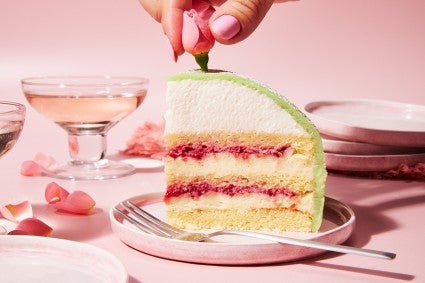
Everything about chiffon cakes is delicate, from the meringue to the batter to the cake itself. So when we tell you that the best way to preserve a chiffon cake's delicate, light texture is to drop the pan full of batter onto a hard surface after baking, you may be wondering what we're thinking. But hear us out. At her Los Angeles restaurant Quarter Sheets, pastry chef Hannah Ziskin makes ethereal Princess Cake and a rotating assortment of layered chiffon cakes. In the recipe for her Olive Oil Chiffon Cake, she calls for an unusual step — dropping the baked cake from a height of six inches directly onto a hard surface. But wait, what? Wouldn't that disturb the delicate foam structure you've worked so hard to create? Actually, no.
In the recipe, Hannah reassures, “This seems counterintuitive, but it sets the structure of the cake so that it won’t sink as it cools.” She first read about this technique in Nicola Lamb’s Substack, Kitchen Projects, in a deep dive about genoise cakes with pastry chef Ayako Watanabe. Hannah had been seeking a solution to one particularly vexing issue: While baking slab cakes, she experienced shrinkage during cooling. After reading Kitchen Projects, she decided to give Nicola’s “cake drop” method a try.
“The idea here is that you are pre-empting the potential for shrinking by ‘shocking’ the cake and releasing the pressure between the cell walls,” writes Nicola.
Nicola further cites Peter Barham’s The Science of Cooking, which explains that as steam trapped inside a cake condenses during cooling, the cake can collapse and shrink because air cannot re-enter to replace the condensed steam. To prevent this, both Barham and Ayako recommend the “cake drop” technique, which causes some internal air bubbles to burst, allowing airflow through the cake and helping it retain its structure.
“Essentially, for chiffon (and various other foam-based cakes), the structure is still very delicate when it comes out of the oven,” Hannah further explains. “When we drop it, it's a quick, sharp drop right onto a hard surface from about six inches. This ‘shock’ helps to break open some of the cell structures to allow steam to escape as the cake cools (as opposed to trapped steam condensing inside the cake causing it to deflate).”
Intuitive? Not exactly. But if it means a perfectly light and spongy cake every time, we’re all for it.
Ready to try this technique? It works best with foam-based cakes, including chiffon, sponge, angel food, and genoise.