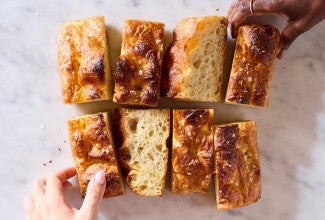




How can I get a more bubbly, open crumb in my focaccia?
Two key focaccia tips from our recent podcast episode.
Date
April 9, 2026


In every episode of our podcast Things Bakers Know, we answer baking questions from our listeners. In our recent episode all about focaccia, one caller asked a very important question: How do I get a more open crumb in my focaccia? Below is an edited excerpt from hosts David Tamarkin and Jessica Battilana. You can find the full episode here.
Jessica: I think some of this comes down to the formula.You want to look for a recipe that's a higher hydration recipe. And I know that there are probably some listeners out there that are like, "Well, how do I know?" And you have to do math.
David: In baker's math, which is the math we're talking about, it's all a ratio. You're breaking down the ingredients into ratios, and it's all based on the total amount of flour. So if there are 1,000 grams of flour in this recipe and 800 grams of water or other liquid, then you have an 80% hydration focaccia.
Jessica: Because flour is always 100%. And everything else gets calculated against the flour. (Read more here: Hydration in bread dough, explained.)
David: Exactly. So what you would do is figure out if it's a high hydration dough. Just look at the ratio between all the liquid versus all the flour. Total up all the flour if there is more than one type — if there's semolina flour, for instance, add that to the all-purpose flour. I would say what counts as high hydration, there's no law around that, but I would say 80%. You can assume that you're going to get a reasonably open crumb with 80% or higher.
Jessica: It’s important to note that an 80% hydration dough, if you were making a shaped boule or bâtard, might make a greener bread baker very anxious, because it's wet and sticky. If you dump the dough out, it's like an amoeba. But that's where focaccia is so brilliant because you barely have to touch the dough.
David: And when you do touch it to dimple it, your hands are coated in oil, so you're not going to stick.
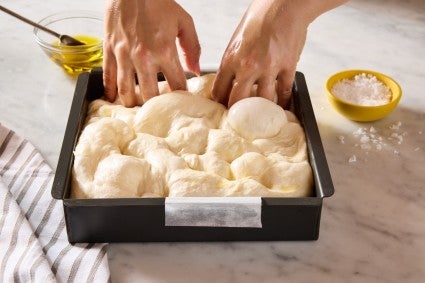
Jessica: It's not sticking like crazy. And the other thing is that you really have to push the proof on it. So when that focaccia is in the pan, you really want to wait. You want to keep it in a warm place. And you want to wait until that dough looks visibly very bubbly. And you give the pan a little jiggle, it should be almost like a marshmallow.
David: That's the benefit of having a bread that's baked in a pan. Because the risk of overproofing is curbed by the fact that it's in a pan. The risk of overproofing a freestanding loaf is that it's just going to spread out, and it's going to lose its shape. But you can push pan breads a little harder in the proof. And this is not to say that you should intentionally overproof all your pan loaves, but for focaccia specifically, if you're looking for something really bubbly with an open crumb, you have to wait to see those bubbles.
Jessica: So those are the two tips. Choose a formula that favors higher hydration; that'll give you a great start. And then give it enough time in a cozy environment to reach its full potential. That's all I want for myself. Enough time in a cozy environment.
David: You know what? You're right, that is a life lesson. Just to give yourself time to reach your full potential, don't rush.
Jessica: Yeah, don't rush.
Cover photo (Big and Bubbly Focaccia) by Patrick Marinello; food styling by Yekaterina Boytsova.