




The simple, one-tool trick to make bright frosting
Putting a popular method to the test.

Date
May 6, 2026

If you’ve ever dumped a whole bottle of food coloring into a batch of frosting only to be left with a pale pastel hue instead of the deep, vibrant colors you were going for, you know that making bright frosting can be a challenge. That’s particularly true when it comes to natural food colorings, which are typically not as saturated.
But helpfully, there is a simple trick to amp up these natural dyes and achieve the super saturated colors of your dreams: Use an immersion blender. Popularized by content creators like Adriana Patterson of Sugarologie and used by food stylist Lydia Fournier in the King Arthur Test Kitchen, this technique involves beating food coloring into Swiss meringue buttercream to dramatically enhance the color. But what effect does it have on texture and taste? Before I share my testing, let’s dive into the science behind these colorful creations.
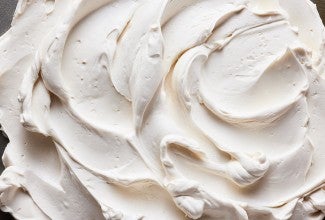
Meringue-based frostings like Italian or Swiss Meringue Buttercreams, which are made by beating softened butter into whipped meringue, are prized for being velvety smooth without being overly sweet or greasy. This texture is all thanks to the large amount of air that gets incorporated via whipping. Essentially, meringue-based buttercreams are whipped emulsions with a delicate balance of water, fat, and air that forms over a long period of mixing.
Here’s where food coloring comes into play: Natural food dyes and other water-based dyes work by joining the water molecules found in buttercream. But because the water is suspended in an emulsion, it can be difficult for the food dye to bind with it; the emulsive nature of this type of frosting can basically behave like a raincoat, naturally resisting the addition of new ingredients. That's why colored frosting tends to result in soft pastels, rather than vibrant hues. And while you may think the solution is to simply add more dye, adding too much could actually break the emulsion you worked so hard to achieve. Instead, turn to an immersion blender to up amp up your color.
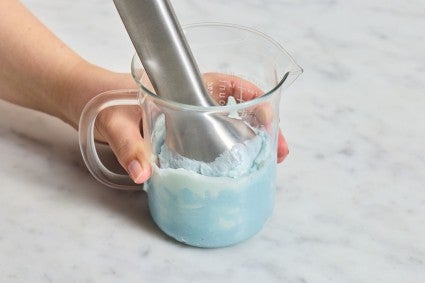
When you use an immersion blender to beat frosting, the tiny molecules of fat and water become smaller and closer together via force and the heat created by the spinning blades. The food dye no longer just passes between these molecules but actually gets incorporated into a greater number of them, resulting in a glossier surface and vibrant color throughout.
(I recommend sticking to an immersion blender: In my experience, continuing to whip a buttercream longer in a stand mixer actually results in a lighter color due to the increase in air incorporated while whipping.)
There is one potential downside, though. I was curious to see what effect using an immersion blender would have on the air that’s so vital to Swiss meringue’s texture. Would the immersion blender decrease the volume of the frosting — or worse, turn all my hard work into a soupy mess? Only a side-by-side test could prove if this added step was worth the time.
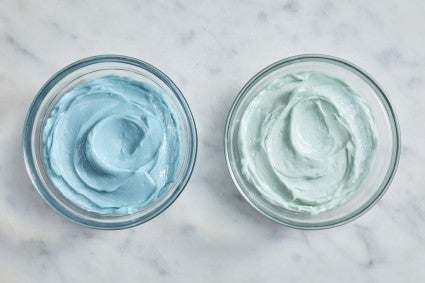
I used King Arthur’s Swiss Meringue Buttercream recipe for all six rounds of my testing, and tinted them with different colors. My goal was to see the effect an immersion blender had on each batch’s appearance, texture, and taste. For each test, I divided my finished buttercream, then mixed various concentrations of food dye using my stand mixer on half and an immersion blender on the remaining. I stopped once the color seemed to be at maximum concentration (about one to two minutes) and made side by side comparisons between the two groups.
The immersion blender clearly resulted in more vibrant colors: The color of each immersion-blended frosting sample was noticeably more saturated than that of the standard mixing method. The colors appeared more like their true versions rather than just softened tints.
Blending resulted in slightly denser frosting: Each of the immersion-blended tests had a noticeable increase in sweetness due to the increase in density. These samples also tasted smoother and more buttery.
Takeaway: While this technique provides impressively vivid colors and a high gloss sheen to any batch of meringue-based buttercreams, my results revealed the importance of air when it comes to taste and texture. I did find a happy middle ground by gently folding one cup of the immersion-blended buttercream back into the bowl of unblended buttercream. This resulted in a frosting that was still vibrantly colored but retained more of the texture and flavor unique to Swiss meringue buttercream. While I may not use this handy technique to decorate an entire cake, for smaller embellishments and piped details like frosting cupcakes, it’s a great way to add pops of vibrant color.
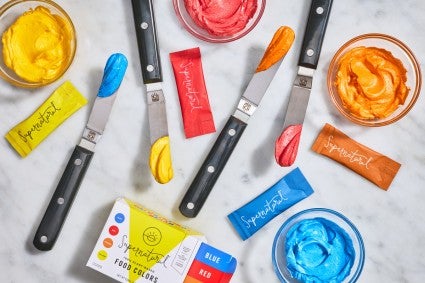
For the immersion blender to work most efficiently, be sure the blades are fully beneath the surface of the buttercream and use a container with high sides to avoid messes.
Avoid using an immersion blender on the buttercream for too long, as the heat from the spinning blades will cause the buttercream to liquify. If this happens, allow the mixture to solidify again (either briefly in the fridge or at cool room temperature) and rewhip back to a smooth texture.
I found that this technique worked best with darker pigments like black, purple, and red.
Cover photo by Patrick Marinello; food styling by Lydia Fournier.