





Recreating Radio Bakery's Iconic Topped Focaccia
Martin visits one of his favorite spots: NYC's Radio Bakery, where they make incredible topped focaccia. This maximal take on focaccia sports a fluffy crumb and a healthy heap of delicious flavors on top. In this video, Martin talks with Radio's owner Kelly Mencin about her style of focaccia – then we create an at-home version, loaded with onions and smoked cheddar.
- Hey friends, Martin here. We're in the studio today and we're talking about one of my favorite bakeries in all the land. It's Radio Bakery down in New York City. Recently I was able to actually talk to Kelly Mencin and we went through each aspect of how they treat their focaccia. I tell you, it was eye-opening for me and I did my best to write a version that will work in the home oven and in a home time-frame, but tastes as delicious and has that sort of maximal focaccia treatment that Kelly does. Kelly, introduce yourself.
- My name is Kelly Mencin. I am the chef-owner of Radio Bakery in Brooklyn, New York. We have two Radio Bakeries, one in Greenpoint, one in Prospect Heights. I'm the culinary director and I oversee the menus of both locations and the bakery chefs at both locations, making sure that everything we make is tasty, consistent, and super delicious.
- When it comes to the menu at Radio, tell me, like, what drives your sort of, like, creative vision? What's your ethos around food? Like what's driving you when you go to write these incredible menus that all of us are celebrating at this point?
- Oh, well thank you. I think the biggest thing is like craveability, and craveability, a little bit of nostalgia, and just like simple, can I swear on here?
- Go for it.
- No? So like, just simple delicious. We try not to be like too pretentious and just make things that, like, we want to eat and that people want to eat and, like, pare it down as much as possible so that it's super straightforward and there's no fluff.
- Okay, so let's make this preferment. You know, most good bread begins with this sort of bouillon cube of fermentation as I sometimes say, which we refer to as a preferment. It's a portion of the dough that begins the day prior. We allow it to mature and develop flavor overnight. And then on day two we go to the mix. At Radio, Kelly is using a liquid preferment and she's using a little bit of whole wheat in there. I love that. It gives it lots of healthy activity, it gives it lots of flavor as well. And so for this liquid preferment, that's what I'm doing as well. I've got some water here, 68 grams, and this is gonna rise overnight so the water is cool, okay? Nice, cool water, 68 grams into the bowl. Okay, let's get some culture in here. 14 grams of ripe sourdough culture. Just a little bit. And then I'll get some flour in, 59 grams of bread flour. This is basically an equal-parts flour and water mixture, okay? So we would call it like liquid levain, or maybe you just call it sourdough at your house. And only 10 grams of whole wheat. So again, those numbers are 68 water, 59 white flour, 10 grams of whole wheat, and 14 grams of sourdough culture. Get a lid on it, leave it at room temperature. We'll be back in 12 to 16 hours and we'll make some focaccia.
- Our focaccia recipe was created during the pandemic by one of my business partners, Rafiq, created it in his apartment in Brooklyn, New York. And it's gone through so many iterations that, you know, the first scaled version of it was, you know, two sheet trays in a home oven blasted at 500 degrees, right? And now we can make up to, we're making up to 60 a day in, like, these special pans in the bread oven, so it can be made, you know, I feel very confident that anyone can make it no matter where you are. For our focaccia, we only use King Arthur Special Patent bread flour. It's the bread flour that they sell in stores, right?
- Exactly.
- It's the same thing.
- Yep. Flour, water, salt, and a very small amount of yeast. Any olive oil in the base dough?
- [Kelly] No olive oil in the base dough.
- Okay. Okay, cool. Good to know.
- Lots in the pan.
- Yep. Okay, got that.
- But basically, it basically fries in the olive oil.
- So good. Okay, let's make this Radio Focaccia, or what I feel like is my like honorable, like, attempt to try and make something quite as good as what they do down there. So I'm gonna start with bread flour in the bowl, I've got 205 grams. And you know, whenever I visit bakeries, I'm always trying to snoop around and see what I can see from the counter. Sometimes I know someone and I can sort of find my way back into the bakery proper and I always like to sort of snoop and see what they're using for flours. And I'm always excited when I see some of our wholesale flours in use. That's not uncommon and I love that. So I've got 205 grams of bread flour in the bowl. We're making focaccia today. I want a nice, high rise, so I'm using my bread flour. I've got a little bit of yeast, three-quarters of a teaspoon, and then I've got a teaspoon of salt. Give those a little stir. And then I'm gonna get some water in here. It's 150 grams and it's lukewarm. And I've got a tablespoon of olive oil. One of the spots in this recipe where I sort of diverged a little bit from what Kelly does is that she doesn't put olive oil in her base dough. And I tried to do it that way for a while, but I just couldn't get the tenderness that she has for whatever reason at home, because it's a different kitchen, because of all the sort of multi-factorial stuff that goes into baking. I just couldn't get the crumb that I really liked. And so I went back to adding just a little bit of olive oil. So it's just about a tablespoon, 15 grams, 14 grams. 13 grams, 13 grams of olive oil. And I think that's okay. You know, I'm not trying to make like an exact replica. I'm trying to make something that eats with as much deliciousness and texture as what she does. And so at points I had to sort of like change some things and you'll see more of those as we go along. But I think in the end, the result is something that does honor the style that is so good at Radio. Okay, beautiful active preferment here, it's bubbly, it's got little fissures on the surface. I can see those tiny little bubbles coming through. A beautiful active preferment. Remember it's got a little bit of whole wheat in there, which brings even more brightness and more flavor and more activity to our preferment. Okay, so just stir it together, clean the sides of your bowl on the early side before things have a chance to dry out and you won't leave a bunch of extra flour up there. Flexible scraper, clean the spoon. So looking pretty good. So far looks like a soft dough, which is what I want. With my hand I'm gonna go in and just give it a little bit of almost like a massage knead. If you want, you could even give a little bit of a knead in the bowl using this method that people like to call the Rubaud method. Something that an old French baker up in northern Vermont was real fond of doing for his home baking and it sort of mimics the action of a spiral mixer. So I don't need to get any more done than that. Like I said, clean the bowl, don't waste anything. Okay, you could leave it in the bowl to rise if you want. That's perfectly fine. Just make sure you have a good cover on it. I like my little portable two-quart container. It's like my little best little baking buddy. It's a little bit easier to see the level of rise in a container which has a square side wall, you know what I mean? So it's like if I'm really concerned about, oh, do I want a doubling or do I want a one-and-a-half times rise, I can see that vertical progress through the sort of sidewall of my little container, so it can be handy. I don't see my mother ever transferring a dough out of a mixing bowl though, so you know, you do you. Okay, beautiful soft dough. So soft, that might be a little bit concerning, but it's not. It's fine. It's in the 80% hydration range, which is right where Kelly's dough lands. Get a lid on it. We're gonna set a 15-minute timer and then we'll come back and we'll do our first fold. Do you have any tips?
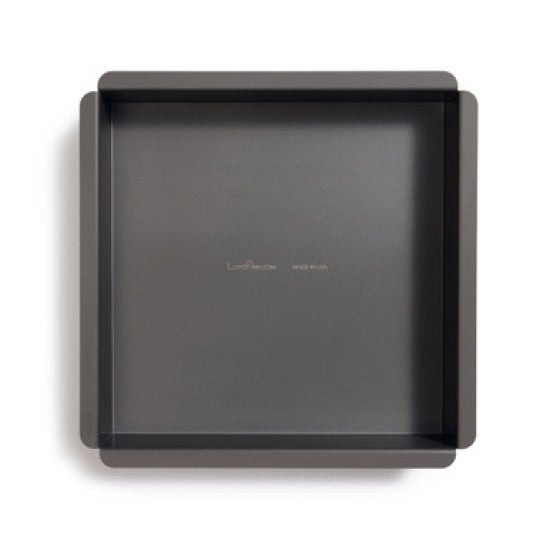
- [Kelly] Don't be afraid of a wet dough, okay? Don't be afraid of hydration. Push the hydration level, that's gonna make the crumb super open and creamy. And just work on your fold, adding more folds if it seems too wet. Okay, we're back. It's been 15 minutes, maybe a little bit longer, and let's see what we got going on here. Very soft, gaining some strength, gaining a little bit of extensibility, but pretty soft still. So let's just give it a bowl fold and, boy, it immediately begins to sort of say, "Hey, I do have a backbone," which I like to feel. I like to turn it over so it's seam-side down. You don't have to do that. Get a lid back on, put it someplace comfortable. We'll be back in 15. Okay, back for the, what, second fold? Second fold? Yes, fold number two. The dough looks good. What I'm seeing, and I hope that you see this as well, is that along the sidewalls of the dough, it's gaining strength. And how I know that is that it has this more rounded aspect to it. It's not totally flat. If it's totally flat, it just means that the dough doesn't have a lot of energy yet. In this case I can see that those sidewalls are starting to round out a little bit and that tells me that we're developing some strength. The dough's ability to hold things and rise upward is increasing. I can also feel how it's less apt to sort of shred at this point, which I really like. Beautiful, slightly tuggy, beautifully smooth. Could easily pull a windowpane. So just a little bowl fold here. If you wanted to do a coil, you could do that as well if coil is in your sort of repertoire. And we'll be back in 15 minutes for the next fold. All right, so third fold. Dough continues to look very happy. What a change, man. It's miraculous. Where would we be without wheat? We wouldn't be making anything like this, that's for sure. Beautiful sort of elastic network. Wheat is kind of the only thing that can do that. So just a gentle bowl fold and then I sort of rounded it, turned it over so that the seams are down. We're gonna give it another 15 minutes or so and then we'll come back for the fourth and final fold. Fourth and final fold for this Radio Focaccia. And the dough is coming along real nicely. Early on I was thinking, "Hmm, this dough feels a little bit weak today," but no, I was wrong. It's beautiful, beautifully stretchy, gorgeous, gorgeous dough. So I'm gonna give it just sort of like a once around and then I'll turn it over and then we're gonna give it 120 minutes to rise at room temperature. And when we come back we should have a pretty puffy dough. At this point in the process, Kelly will put hers into the walk-in overnight for an extended amount of sort of fermentation. You could do that too. Just know that on day two it's gonna take quite a while for that dough to sort of wake up and get back on track. So allow for that. But if you wanna stick to this one-day process, which I think works very well, and I think it's the first one that you should try, 90 to 120 minutes at room temperature until we have a nice sort of puffy dough, and then we'll dump it into our pan and we'll proceed to the baking stage. So the dough is risen, it looks good, it's like doubled in size or something. It's around there, it's active, it's happy. There is a little bit of yeast in there. We also have the leavening power of the sourdough as well. When Kelly does her dough, she also does use a little bit of yeast. If you wanted to do it with an all-sourdough process, yes it will work, yes, your timelines will be more protracted and because of that you might end up with something that's a little bit more aggressively sour. I feel like this is balanced for me and we can achieve something really good without too much time. If you take the yeast out, you're definitely gonna have a little bit more babysitting to do. And maybe I should say just briefly, I'm using this beautiful Lloyd pan. It's like 9" x 9" on the interior. It's the pan that we used for our Recipe of the Year focaccia. Okay, so tablespoon of olive oil into the pan. And man, when they oiled the pans at Radio, it's generous. It is very generous. So this is generous. It's maybe not quite as generous, but I feel like the topping combination that I ended up with here adds a fair amount of richness and I think it's balanced. So let's see if I can get this out without being too rough on it. Just gonna invert it and let it sort of pull itself out. There you go. Whoop. Still pretty soft. Okay, and then what I'm gonna do is I'm gonna invert it once just to make sure that I have olive oil on both sides. And as I do that I might just give it a little bit of a tug just to sort of get it moving towards the corners. It's always hard to go from round to a square. If you have a square container, you could use that for the rise. And then when you go in here, the dough naturally will fall into the corners a little bit. So I'm just giving it a little bit of gentle encouragement into the corners. So I've got my dough into the pan. It's not perfect, I've got a little bit of like a gap in the corners, but as the dough rises again, it's gonna fill into that. And maybe before the bake I might just encourage it just a little bit. Let's get it covered and we're gonna put it in a warm spot to rise one final time for about an hour and a half to two hours until it looks puffy, or until everyone's like, "Dad, when is dinner and is it ever happening?" And you finally say, "Okay, we're gonna get this thing in." So, hour and a half to two hours, comfortable spot. While it's rising, I'm gonna prepare my toppings. And then before we know it, hopefully time to enjoy some focaccia. I'm back, I forgot to tell you about the oven. So about an hour before you're ready to bake, get your oven on, 475, get a stone or steel in the lower third, and get that thing preheated ripping hot, but also have a rack in the upper third as well, because we're gonna start it down low and then we're gonna finish it up high. So get your oven going about an hour before you're ready to bake, 475. Don't forget. Can you talk a little bit about your approach to toppings?
- [Kelly] We keep it like dumb-simple. You know, it's not a sandwich, it's a focaccia. And so it needs to be like snackable I guess instead of like heavy, like a sandwich.
- One of the most compelling things about the focaccia that I have every time that I go to Radio, and it doesn't matter which one I get, whether it's the one that's like tomato-flavored or whether it's one that's like a breakfast sandwich or shakshuka or the one with mushrooms or whichever it is, it's always a sort of maximal treatment of flavors for me. The tomato is super jammy. The mushrooms are reduced and beautifully flavorful. The shakshuka has some sesame seeds on there. Kelly has a way of thinking about flavor that is intense and it's amazing and it's one of the most compelling aspects. And so when I went to try and figure out what I was gonna do for this treatment, I went with onions and I also went with smoked cheddar. I feel like they work really well and the quantity of onion is gonna surprise you because it looks like a lot. It is a lot. And that's on purpose. It's all part of this attempt to make something that to me is as compelling and sort of maximal as her focaccia. So it's a lot of onion, I'm just telling you right now. And, you know, normally when I put onions on things like pizzas, normally, or often I would say, I pretreat them, but I think in this case the onions actually work really well going on top raw. During baking, these onions reduce down and they mix in with the smoked cheddar. I want these onions sliced very thinly so that during baking they sort of reduce down a little bit. This is a nice fresh onion, I feel like I feel a good cry coming on. Should have gotten out my onion goggles or something. Okay, it's a beautiful, almost like, I don't know, they're not matchsticks, but you get the idea. They're very thin. Oh, it's crushing me. My eyeballs. Okay, let's get these outta my face before I start sobbing. I haven't been hammered by an onion like that in a little while. Woof. And now I've got some really good local smoked cheddar from Garfield's Smokehouse just right down the road here. Love, love, love this smoked cheddar. Need 113 grams of smoked cheddar. So I grated my cheddar, it looks great. I don't tell nearly enough dad jokes. Mix that a little bit to combine. You don't wanna do this too far in advance. If you do, the onions will sweat out a little bit and that probably won't hurt anything. But just while your oven is preheating, this is not like a long chore, right? It's pretty quick. And then a little bit of salt, we got about half a teaspoon here. And then like I said, a little bit of red pepper, one teaspoon. It's optional. I recommend it. But if you've got kids in the house, sometimes they're a little bit iffy on the spicy stuff so maybe you use black pepper or maybe you use like maybe smoked paprika or something like that that doesn't have heat, but it does bring some of that extra. Give it a little toss to combine. My oven is coming up to temp. I think we're about ready to do some baking, so get yourself ready, we'll be back. Okay, so dough's had about an hour and a half. We're on the kind of early side of it, but I think it looks good and it's pretty much filling the pan. I may not even need to dimple it at all. Maybe I will, just a little bit to show you that if you want it to be into the corners fully, you can dimple just a little bit. Don't get in there and mash it, like, you know, you can in some cases. This dough is a little bit more fragile than that. So what I'm gonna do is just with my fingers wet, I'm just gonna go to right where the corners are and I'm just going to push it into the corner just a tiny bit. And just a tiny bit. And I think that's good. Okay, so I'm gonna get it into the oven. I'm gonna put it onto the preheated baking stone or steel, whichever you have will work. I'm gonna bake it for about 10 minutes. Toward the end of that time-frame, I'm gonna take an offset spatula and I'm just gonna peek underneath just to make sure that I have the level of color that I want. If I don't have a like a deep golden brown at that point, I may give it just a little bit more time. But once I achieve the color that I want on the bottom, that's when I'm gonna pull it back over to the bench. I'm gonna add my toppings and then I'll return it to the oven. The reason that I'm doing this bake in two parts, similar honestly to the way that I would do like a Detroit-style pizza or something, is that I found that because I'm adding so many toppings, if I added them at the inception of baking, it was compromising the structure and I wasn't crazy about that. So I'm delaying the addition of the toppings for structural reasons. It also helps honestly to really make sure that that bottom crust is super crunchy and crisp. I think that the result, while different than the method that Kelly uses at Radio, the result is closer because of this sort of two-step process. So let's get in the oven. As we approach about the 10-minute mark or so, I'm gonna peek under and make sure that the color is good. Okay. Man, that pan is hot. Hot, hot. Okay, so we did the first portion of the bake. It was exactly 10 minutes. I think on the recipe we say 9 to 11. The main thing that you're looking for though, really more than at the timer, is you're looking to see if the bottom is a little bit, you know, beautifully browned. And that's what I want. I want that level of color on the bottom. Remember that now I'm gonna top it and then the remainder of the bake is gonna be on a rack in the upper third of the oven, right? So now let's get it topped. Just like when you're working with the Detroit-style, remember that the pan is very hot, so don't touch the pan. And do your best to sort of get the onions and the cheese out to the edge. I actually really like it when the onions get a little bit dark, the cheese will melt, all of those good things will happen. I'm just making sure that they're relatively well-distributed. That's a lot, right? That's a lot of toppings.
- [Tucker] It is. ♪ Ba-da-ba ♪ ♪ Ba-da-ba ♪ ♪ Ba-da-ba ♪ ♪ Ba, ba, ba-da-ba ♪
- Ooh, it smells so good in here. Am I right? I'm just getting this out of the pan. I've got my little fish spatula here. You could use a paring knife or something like that. I'm being gentle. I'm not scratching the pan, nobody worry. I'm just gently, gently making sure that I don't lose any onions on the way out. I really like this sort of dark spots here. Around the edges of this, the onions and the cheese almost do like a little bit of frico, as you would with, you know, I don't know, a delicious Detroit-style or something like that. And I'm just making sure that I don't lose any, so I'm being a little bit careful there. Okay. I'm out of the pan. There it is. Boy, the studio has this perfume. I'm sure that when I walk in the house at home today, someone's gonna be like, "Hey, did you start smoking or something?" Because it's very smoky. The smoked cheddar on this has this incredible aroma. That combined with the sweet onions, I tell you what, it's one of the most aromatic things that I've made in a long time. I got the focaccia out of the pan, and one of my favorite things about this is the way that the onions sort of crisp and the cheese crisps along that side. The bottom crust is really nice. Gorgeous. Look at that. I know that the dough is gonna taste good. We took a lot of care with it. Remember it was this really nice liquid levain with a little bit of whole wheat added in it, gave it so much activity overnight. I know that that activity sort of carried itself into the dough. We made a nice, very supple dough. The toppings are definitely maximal, a lot of onion and a lot of smoked cheddar. I'm trying to sort of do the honor that Radio Bakery in New York City deserves in terms of the amount of flavor and intention that we're bringing, not only to the dough, but also to the toppings. Let's let this cool just for five minutes or so, and then I'm gonna come back. I've got some chives to garnish it with. We'll cut it, we'll have a look inside and see how the structure is. We'll see how it smells, and I'll enjoy a bite of this beautiful Radio-inspired focaccia. So Kelly, thank you so much for taking the time. I know you guys are busy.
- I mean, come on, King Arthur, like, I'd drop anything for you guys.
- Please. Well, that's kind. I don't know if we feel that celebrity, but we certainly celebrate it. Gorgeous structure, right? I can see in the crumb here just a little bit of fleck of whole grain. I love that. I love this very, very thin, thin, thin crust and this pillowy-soft, light interior. It's really that textural contrast which we're chasing. I'm chasing it with focaccia, chasing it with Detroit-style as well. It looks like it's gonna be heavy. It's not at all. It's really, really good. So listen, y'all, I did my best to sort of honor, in a way, this incredible bakery that I love so much in New York City. It's Radio Bakery, they have a couple locations, and this focaccia is something that's just inspired by how much care they put into even the small things. So this is Martin, with Tucker behind the camera and Kat over there in the side kitchen, keeping me on track and in line. I appreciate everyone. Thanks for joining us here, and stay tuned for more great content coming from the King Arthur Baking Company.
Video Credits
Shop this video
Related Videos

Your bread fell flat. Your cookies crumbled. Who do you turn to?