



This rule makes every pizza better
Toppings may go on last, but they’re the part of the pizza you should think of first.



Nothing destroys a pizza faster than an undercooked mushroom. Too firm, chewy in all the wrong ways, and also somehow … sweaty … it is one of the serial killers of great pies, matched only by undercooked onions (crunchy, pungent) and suspiciously chewy bacon. We should all know to avoid these obvious offenders by now. But think about it: When was the last time you suffered through a pizza that essentially had a hot raw salad on top? Whenever it was, it was too recently.
Pizza toppings can be surprisingly tricky. They are the last things to go on a pizza, and, accordingly, often the last thing a pizza-maker thinks about. But in the course of working on The Book of Pizza, I came to think of toppings as the anti-afterthought. They are now the part of the pizza-making process I think about first. Because toppings are needy. They require attention and preparation, and often more time than you might think. And while technically you can scatter raw, unseasoned vegetables over a pizza and call it a day, you never should. Raw vegetables contain water that seeps out when placed in a hot oven, making your pizza unpleasantly wet and soggy. And because pizzas are typically in the oven for only a short amount of time, what goes on top of a pizza raw will often still be raw when you pull it out.
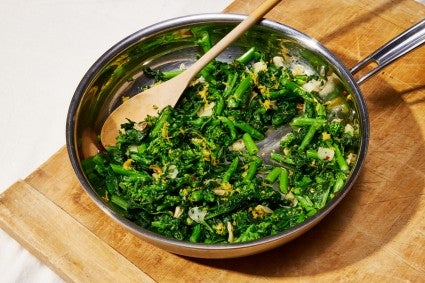
So here’s a rule that makes every pizza better: Every topping — yes, all of them — needs TLC before it goes on top of a pizza. Different toppings need different things. Some need to be chopped and roasted, others need to be torn and wilted. But all of them need something, otherwise they will not enhance your pizza, but destroy it.
For the book I wrote a comprehensive guide on how to prep all kinds of toppings, from greens to garlic to ground meat. But the fundamental strategies for each topping are more or less the same, and can be boiled down like so:
Toppings need to be trimmed. This is pretty obvious. Everybody knows you don’t put a whole head of broccoli on a pie; it has to be chopped into bite-sized pieces first. But pizza bakers often underestimate just how small the pieces really need to be in order to 1) cook through in the oven (though see my next point), and 2) provide a good eating experience. Opt for bite-sized or slightly smaller. Chop greens into quarter-sized pieces, not long strips; shave vegetables like potatoes on a mandolin for thin slices that get both creamy and crunchy.
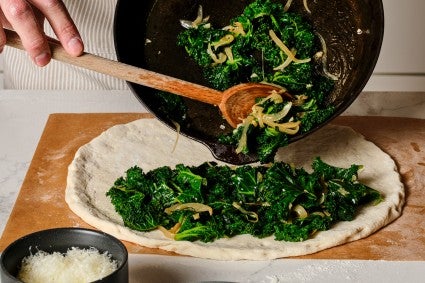
Pre-cooking is key. It is extremely rare that a vegetable can go on a pizza raw. Very thinly sliced Brussels sprouts can work, and so can garlic (again, thinly sliced). But almost everything else needs to be tenderized by a pre-cook. Roasting is a great option, because you need to turn the oven on to get it preheated for the pizza anyway — why not put that hot oven to work while you wait? Sautéing is also great for wilting greens, caramelizing onions, browning ground meats and sausage, and getting fried eggs with set whites and perfectly runny yolks. (Don’t crack raw eggs on a pizza and hope they will cook perfectly in the oven; that’s something only the pros can pull off.)
The season is the reason. Always season your vegetables before you cook them. And know that, sometimes, salt is all you need. Thinly sliced tomatoes and shredded zucchini can go on top of a pie if they’ve been salted, left to sit for a while, and then drained. The salt extracts excess water from the vegetables, but also ensures they’re seasoned inside and out.
Like every rule, this one has a few exceptions. The biggest one is pepperoni. The world’s most popular pizza topping also happens to be the one that doesn’t need any prep. The same is true for other cured meats, such as soppressata, which are ready-to-eat and already highly seasoned. Raw vegetables also have more of an opportunity to cook through on pan pizzas, like a Detroit-style pie, because they spend more time in the oven. But even then a little pre-cooking doesn’t hurt. Golden sautéed mushrooms will only become more caramelized in the oven, while raw mushrooms will ultimately still be a gamble. And who wants to gamble with a sure bet like pizza?
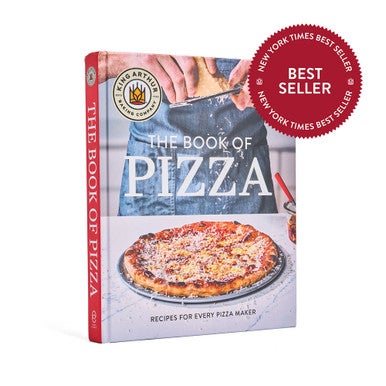
Cover photo by Andrew Thomas Lee; food styling by Yekaterina Boytsova.