



Baking trials: Will a baking stone fix my oven’s hot spots?
A surprising use for this bread-baking tool.

Date
January 21, 2026


When you preheat your oven to 350°F, you might assume its interior is a nice, even temperature throughout. Far from it! Every oven will bake more (or less) quickly in different locations, from top to bottom and front to back. In order to avoid burning your cookie bottoms or charring your cake’s top, it’s good to know where your oven’s “hot spots” are. (Here’s how to test them.)
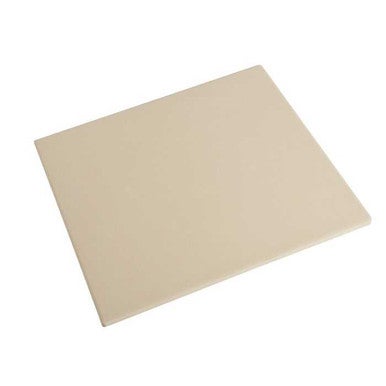
Once you’ve identified those spots, what can you do to fix them? Our King Arthur Test Kitchen experts thought positioning a baking stone on the floor (or bottom rack) of the oven, where the main heat source is usually located, might help.
Baking stones are typically used by bread bakers, since they can be significantly hotter than the surrounding air in the oven. Place your risen loaf directly on a stone, and it’ll rise dramatically and develop a super-crispy bottom crust. If you're not baking directly on a stone, it helps shield baked goods from the searing effects of direct heat, and redistributes that heat evenly throughout the oven. In addition, the stone's thermal mass helps mitigate large temperature swings when you open your oven door to rotate sheets of cookies.
Using a stone to alleviate hot spots sounds reasonable; I decide to find out.
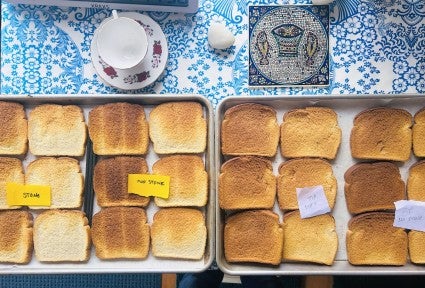
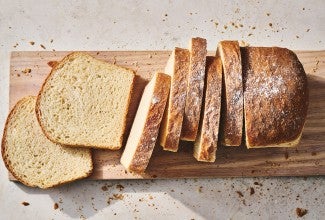
Since I used slices of white bread to identify my oven’s hot spots in an earlier test, I decided to replicate that method, this time adding a baking stone.
I performed three tests:
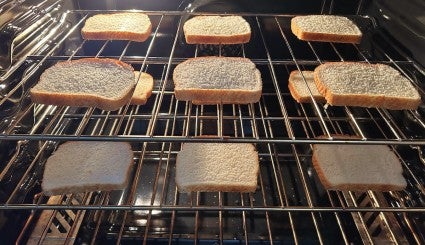
My electric oven’s bottom element is covered by a solid metal floor, which made it easy to simply lay the stone on that floor. I used store-bought sliced white bread, positioning six slices on the center rack and six on an upper rack. I toasted the bread until the slices closest to the center (middle rack, middle slices) turned a light golden brown.
In addition, two of my colleagues — Content Editor Rossi Anastopoulo and Associate Editor Tatiana Bautista — performed the same test in their own homes, since every oven is different.
While all the slices of bread didn’t toast identically, there was less variation when the stone was used, most clearly between each slice’s top and bottom sides: in the absence of a baking stone, the undersides of the toasts were much darker than their tops. Clearly, a baking stone in my oven will help prevent the bottom of my cookies, cake, or pastries from browning too quickly.
And while the bread toasted faster around the oven’s sides, as well as at the back of the oven compared to the front, a stone tempered that difference as well. Yes, there were still hot spots, but their intensity was reduced. No matter its position in the oven, the toast wasn’t as deeply browned when a stone was in place, nor was there as much variation in browning, slice to slice.
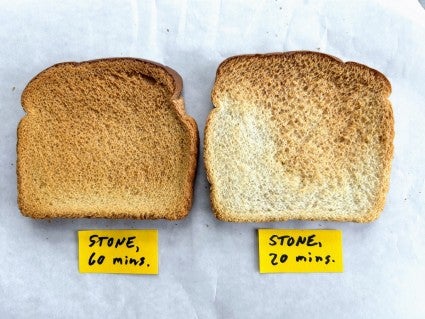
And what about the difference between preheating the stone for a shorter or longer time? It made a difference: When the stone was fully preheated (for 60 minutes), the toasts tended towards an even brown across their entire surface, rather than appearing splotchy.
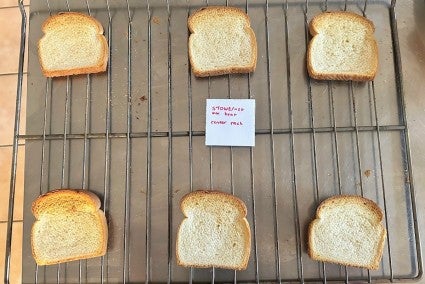
Tatiana’s gas oven yielded results similar to mine, with the stone reducing the intensity of hot spots and providing a more even bake when preheated for 60 minutes. Rossi tried the test in her gas oven. Unlike Tatiana and me, the baking stone didn't make a noticeable difference in browning (though she noted her oven didn't have many drastic hot spots to begin with).
Bottom line: In our home oven tests, a baking stone made a difference 66% of the time.
A baking stone, while not the perfect fix, may help reduce the effect of your oven’s hot spots. If you have a stone, it's definitely worth trying. Here are a couple of things to consider:
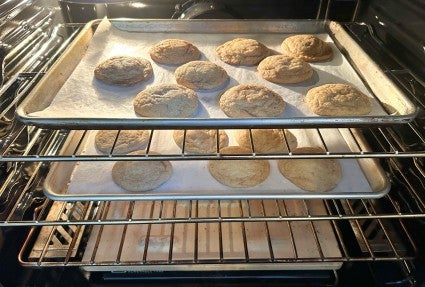
Is there another way to address hot spots in your oven? See Convection oven baking: Why this baker is a fan.
Cover photo by Patrick Marinello; food styling by Yekaterina Boytsova.