




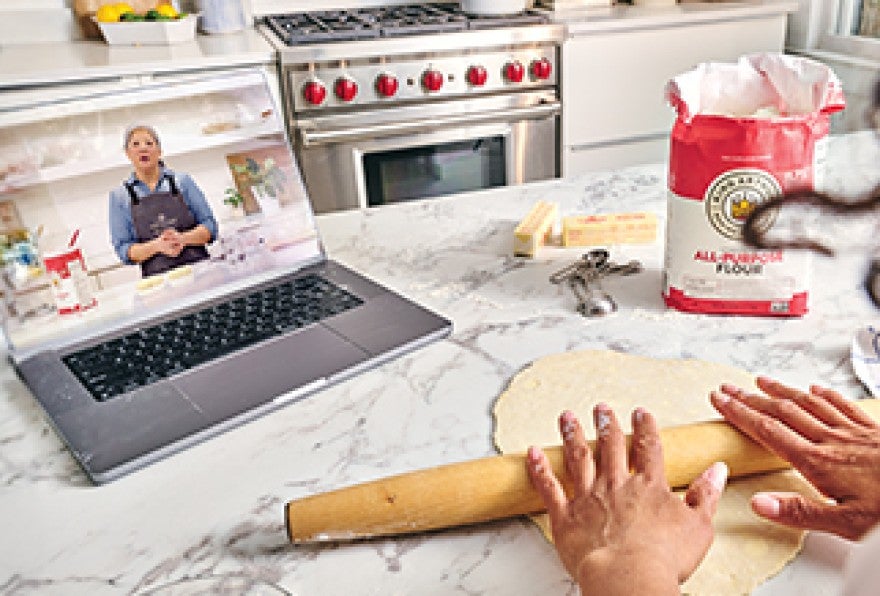
Ultimate Flaky Biscuits
As delicious as they are impressive, these towering biscuits consist of layer upon layer of flaky, buttery dough. This recipe leans on smart techniques to guarantee maximum height and layers: butter that's shaved into sheets on a box grater; a combination of sour cream and ice water to hydrate further; and dough that gets rolled thin, quartered, and stacked, creating even more layers and flakes. Pair these beautiful biscuits with jam or breakfast sandwich fixings, although ... they’re so good on their own, you may never make it that far.
- Hey, y'all, Martin and Tucker here in the studio today, and I've got our Ultimate Flaky Biscuit recipe.
I've made some a little bit oversized, and I've got a breakfast sandwich. This is an incredible addition to our lineup of biscuits. The ultimate flaky, super tender, crispy, crunchy, unforgettable, only biscuit you'll ever need recipe down there in the link below. Come along for the recipe.
All right, so we're gonna get started with our self-rising flour today. We're using self-rising flour today because we want a tender biscuit, and it's also just a little bit easier, right? It's already got some of what we need in the bag. So 452 grams of self-rising flour into the bowl. That's about four cups. If you really want a good biscuit, what's gonna be important is that controlling the quantity of liquid as it relates to the flour. Also, fat is really important in there. But how do we control those ratios? The way that we control is our best friend here, the scale, right? By controlling those ratios, it's gonna give us the flakiest, most tender biscuit possible. The scale, as important with biscuits as it is with baguettes, croissants, or a beautiful chiffon cake. To my self-rising flour, I'm gonna add a little bit of sugar. It's about two tablespoons, or 25 grams. It's not a lot of sugar, it's just a little bit. They definitely don't taste sweet. Next up, I'm gonna add my butter. You know, this is one of those points in the recipe which I think is really unique and special and most important, effective. It's effective for getting the flake into these biscuits. And I'm just tossing them in the flour just to coat 'em a little bit. And then what we're gonna do is we're gonna use the cutting blade on a box grater. Often when you make biscuits, you know, you're cutting pieces and then you're sort of pressing them down into leaves. In testing, the Test Kitchen, Sarah Jampel, everybody else over there found that this is actually a really effective tool for getting butter in there in nice, thin, long pieces. And so I'm using it almost like a mandolin. If you feel like the butter begins to sort of get stuck to your hand a little bit, you can dredge in a little bit more flour. I like to have my butter right out of the fridge, nice and cold, nice and firm. That will help you, as well. Things where we want some flake, it's very important to control temperatures, because if the butter gets warm, it can start to express some of the moisture that's in it. Remember, butter is like, you know, 15, 18% moisture. And if it starts to lose that moisture, what happens is that gluten begins to develop. We develop the tug, and that's not what we want. We want flake, not tug, in this biscuit. So everything cold, very important as a sort of key foundational learning with cold butter process. Some people will use a grater. I think this is a better method. Now, what I'm gonna do is just toss these pieces to coat a little bit, and then I'm gonna put this whole thing into the freezer and freeze it for about 15 minutes. So everything in the bowl is dead cold. Remember, the reason that we're doing that is so that the butter doesn't begin to melt and get water into our dough, changing the sort of consistency of it. We want it to be firm, dry, cold. That's our best sort of method for cold butter process. So I'm gonna make a little bit of a well in the center of my cold flour and butter. I'm gonna add ice water. Remember, cold, cold, cold, right? So ice water, 1/2 cup, 113 grams, into the bowl. And this is about as little water as you can get away with. If when we're mixing we feel like, ah, it's still just not quite coming together, we may add a little bit more, but we're gonna do it in very small increments, only 1/2 teaspoon at a time, up to two teaspoons. You really shouldn't have to add more than two teaspoons. Also, some sour cream. So sour cream, more than just heavy cream or something like that, is adding flavor. It's also giving us that creaminess, that sort of lactic hit that we're looking for in a good biscuit, that pairs well with the butter. And it's got a little bit of sour to it, right? Sour cream, delicious. 1/2 cup, 113 grams. And, you know, we're using real butter here, we're using real sour cream. Like, use the sort of full-fat stuff, that's what I would say. Now what I'm gonna do is switch to this flexible scraper. You see me use these things all the time. I really find them pretty indispensable. You could go in with your hand, but think about how messy that's gonna get. I'd rather use this. It's gonna keep my hands a little bit cleaner, and I think it's gonna do a better job, because my hands are hot. So I'm just turning the bowl and sort of trying to get the party started here, getting what liquid I have into contact with the dry ingredients. There will come a point in here where I feel like, eh, that's about all I can do with the flexible scraper, and I'm gonna switch over to my hand. And you may have to use some force here. You know, you may have to press a little bit. That's okay. Don't be shy about that. Because we're controlling the water, that's really where we could sort of mess it up right here. Putting a little bit of force on this dough, a little bit of pressure, no big deal. And I'm gonna switch to my hand. And what I'm gonna do is this sort of pressing and then folding motion. And by pressing down on that dough, I'm sort of opening it up a little bit and allowing it to come in contact with the dry ingredients. And then I'll sort of fold 'em over and I'll press it again. I suppose you could say that I'm kneading, but I'm hesitant to use that word when it comes to these biscuits because we don't wanna go too far. I'm just sort of pressing, getting the dough flattened. And then I'll go in and I'll just fold it over. And I'm just keeping an eye down there in the bottom of the bowl. How much dry ingredient do I have still sort of kicking around down there? And if I feel like it's really not incorporated and I've given it, say, three or four folds, I can go back and grab, like, 1/2 teaspoon of that ice cold water at a time and just add it in until I feel like we're sort of pretty much there with our dry ingredient sort of incorporation. I'm pretty close. I still have some dry, so I'm just give it a little bit more of a press, and we'll see. And if I can avoid it, I'm not gonna add any more water to the dough. Sometimes, if I do have just a little bit of flour in the bowl, what I'll do is I'll just dump that out and I'll sort of use that as my bench flour instead of adding additional flour at this point. So the next thing I'm gonna do is just press this into a rectangle that's about 4x7. So anytime I'm doing pastry work, I've got a ruler or tape measure at hand. It's like your best friend, because if you're measuring things, you're controlling thicknesses. And with pastry, crispness, tenderness, all of those things are greatly affected by thickness. And so what we wanna do is roll to a certain dimension, which guarantees that we have a certain thickness, right? And so first thing that I'm gonna do, get this pressed out to a 4x7. I'm 7, but I'm 4 1/2. I'm just a little bit over, but I think that we're pretty good there. I'm pretty happy with that. Other thing I'm gonna stop and check here is just to make sure that I'm not stuck to the bench. Am I stuck? No, it's good. Maybe need a little bit of flour, but I think for the most part we're pretty good. So now we're ready to roll to the next dimension, which is 8x10. All right, a little bit of flour on top, just a little bit. And now I'm gonna go out to 8x10. So I'm going to 10 and then I need to go to 8. Let's see how my length is. Probably a little bit, maybe even a little over, okay. So if you find that you overroll a little bit, just push it back. It's okay, don't fret about that. And then I need 8 wide. One of the things that I find sometimes when you're rolling like this is that you'll lose those square corners. Just go back with your flexible and see if you can make 'em square again. Just push 'em into a square shape, 8x10. Okay, I like that. Now what I'm gonna do is I'm just gonna brush the surface. So I added a little bit of water so that these layers will adhere to one another and it'll look like one seamless piece of dough, okay? Now what I'm gonna do is cut it in half, right down the middle. Nice sharp knife. Then I'm gonna cut it in half on this sort of left-right axis. And then I'm gonna stack 'em. And I like 'em so that the cut edges align. So I'm just keeping those cut edges together. And then, then I've got this last one, and it's tacky on top, right? So I'm gonna put that side down so that when I go to work with that, I don't have a sticky side up, okay? So tacky sides together for that last one. And now I've got this nice biscuit stack. All right, little bit of flour underneath just to make sure that I'm floating. If you feel like you have a little scrap of dough, get that out of the way, because what's gonna happen is that that little bit of moisture is gonna cause that dough piece to stick. So clean your bench just a little bit, light dusting of flour. Come back in here with my hands, and I'm gonna start by pressing, 'cause I think that's a little bit easier than rolling when you've got that high stack. And what we're trying to do is get a piece of dough that is 4 1/2 inches wide and 8 inches long. So 8, 4 1/2. All right, we're almost there. Last step before we get 'em onto our baking tray is to just trim those sidewalls. You don't have to do that, but if you do, you're gonna see those layers even more cleanly when they bake, okay? So we're gonna trim 'em, and only trimming the smallest amount necessary to sort of expose that side layer, okay? And the way that we've created those layers is by keeping our ingredients cold and by managing the butter, the way that the butter goes in, right? We've tried to leave it in big pieces as best as we could. So now, I've got this precious dough piece, and what I'm gonna do is cut it into eight. If, at this point, you decided that you wanted to make, like, a breakfast sandwich or something like that, what I would recommend is that you roll it a little bit bigger, right? Because I feel like a breakfast sandwich on a biscuit that's almost two inches high is a little bit, like, much, right? And then maybe cut a few less pieces. So instead of cutting eights, maybe you cut six or something like that. So I wanna cut eight pieces that are absolutely, perfectly symmetrical. Okay, so I made a nice long cut down the middle. Now I'm gonna find that perfect halfway point. I guess you could measure. Beautiful. They look really nice. Okay. You know, you wanna bake your scrap for sure. I mean, to me that's, like, baker's treat, right? That's the first thing I'm gonna eat. Onto my parchment-lined sheet tray. And then what we're gonna do is we're gonna freeze 'em for an hour to two hours. And in doing that, we're really making sure that that butter will pop once it hits the oven. We'll get this cleaned up. We'll get our oven hot, 425. And right before baking, we're gonna brush 'em with a mixture of sour cream and water. We'll be back to do that with some cold biscuits. And before we know it, we'll be munching on something delicious. Okay, biscuits are nice and cold. They've been in the freezer for a little bit over an hour. Once they're frozen, you know, a good tip is that you can take 'em, you can put 'em into a Ziploc bag, put 'em back in the freezer, and then save 'em for a rainy day when you wish you had biscuits to pull out for breakfast, lunch, dinner, whatever it is. Before we bake, we need to put a little bit of a glaze on 'em. And what we're gonna do is take some of that sour cream that we already have. We're gonna add a little bit of water to it. It's just a tablespoon of sour cream and two teaspoons of water. Just using my pastry brush to sort of bring those things together, and then I'll brush it on. And, you know, similar to a lot of things that have layers on the side, like croissants, when you egg wash, you wanna avoid those layers. So I'm just gonna keep this on the top part. I don't wanna actually brush the sides. That'll impact my layering negatively. And you wanna be pretty generous. This does actually brown really well. You're gonna see 'em when I pull 'em out. They have a really nice, slightly shiny and well-colored top side. I'm gonna go back through once and just make sure I did a really good thorough job here. I've got my oven preheated to 425. And listen, you know, when you're preheating, oftentimes when that oven dings for the first time, when it says, "Hey, we're fully preheated" and it's only been, like, 10 minutes, give it a little bit of time. Trust me that often, the oven will be hot in the upper portion, but the entire column of air will not be as hot as we want it. So make sure you give a nice full preheat, 425. I've got a little bit of coarse salt. I'm just gonna hit it just a little bit on each top. It's a little bit of crunch, it's a little pop of salt. Delicious. Okay, we're gonna go put these in, and they're going into the upper third of the oven for 23 to 28 minutes. You know your oven well. If you know that you've got a lot of bottom heat, you may wanna put a double tray. You may wanna put these on a second tray so that the bottoms don't take too much color. What I found in our ovens here at the studio is that I don't have to do that. At home, I do. So think about your oven, know your oven. But for now, what we're gonna do is put these in the upper third. We're gonna bake 'em 23 to 28 minutes. Make sure they get nice, full color. Okay, beautiful biscuits out of the oven. Let's have a look. So one of the things that I'm excited about is seeing these layers, this almost laminated effect, right? You remember grating that butter in in those long pieces, giving this those sort of, like, ribbons as they enter the dough? Those act in a similar way to butter does in a croissant or other laminated pastry. It creates these layers. And as long as we manage temperature, cold butter, cold flour, those things, this will really come through. If I go ahead and tear one open, we can see that it separates naturally into these layers. You could almost go back through and peel 'em, you know? And that's because of the way that we handled the butter and other ingredients. So I'm hungry, we're well past lunch here, and I'm gonna make myself a little breakfast sandwich. I rolled some a little bit bigger and cut 'em a little bit larger. I'm just gonna add a fried egg, a little bit of bacon, and a little bit of a mango chutney, and then we'll be off to the races with a beautiful lunch. So this is Martin and Tucker in the studio saying thanks for joining us. You know, biscuits can be a little bit finicky, but they're worth the effort and they're a great item to have in your baking repertoire. I hope you enjoy this recipe, our Ultimate Flaky Biscuit. Woo!

Video Credits
Shop this video

Your bread fell flat. Your cookies crumbled. Who do you turn to?