Sourdough Starter
Sourdough Starter

Sourdough Starter

Whether it conjures up a crusty, flavorful loaf of bread or a bubbling crock of starter, sourdough is a treasured part of many bakers' kitchens. But where does the path to sourdough bread begin? Right in your own kitchen, with your own homemade sourdough starter. The method you'll read here for making your own sourdough starter has evolved over time to best serve home bakers’ needs (for example, our recipe now includes the weight of ingredients first for better accuracy when measuring); making a sourdough starter is equal parts science and art, after all. 

Editor’s note: This recipe was updated in February 2026 to create a smaller amount of starter in response to home bakers’ feedback. If you’d like to make the original amount of starter (227g or 1 cup), see “tips,” below.  

Prep
50 mins
Total
5 days 50 mins
Yield
sufficient sourdough starter for ongoing baking
Sourdough Starter - select to zoom
Our Best Products

Instructions

Prevent your screen from going dark as you follow along.
  1. Note: For best results, weigh your ingredients using a scale when working with sourdough starter: It’s the most accurate and consistent way to measure. Starter volume varies depending on consistency and whether it's fully stirred down before measuring, so we highly recommend a scale for maintaining and baking with sourdough. However, if you prefer to work with volume measurements, please be sure to measure your flour the King Arthur way: gently spoon the flour(s) into a cup, then sweep off any excess.

  2. Day 1: In a non-reactive container (such as glass, crockery, stainless steel, or food-grade plastic), combine the flour and water. (Make sure the container is large enough to hold your sourdough starter as it grows; a 1/2 to 1-quart capacity works well.)

  3. Stir everything together thoroughly; make sure there's no dry floury patches on the bottom or sides of the container. Cover the container loosely and let the mixture sit at warm room temperature (about 70°F) for 24 hours. See "tips," below, for advice about growing starters in a cold house.

  4. Day 2: You may see no activity at all in the first 24 hours, or you may see a bit of growth or bubbling. Either way, transfer the starter to a bowl. Into the now-empty container (there’s no need to clean it), place 50g (scant 1/4 cup) starter; discard the remainder.

  5. To the container with the starter, add 50g (generous 6 tablespoons) all-purpose flour, and 50g (scant 1/4 cup) water. Mix well, cover, and let the mixture rest at room temperature for 24 hours.

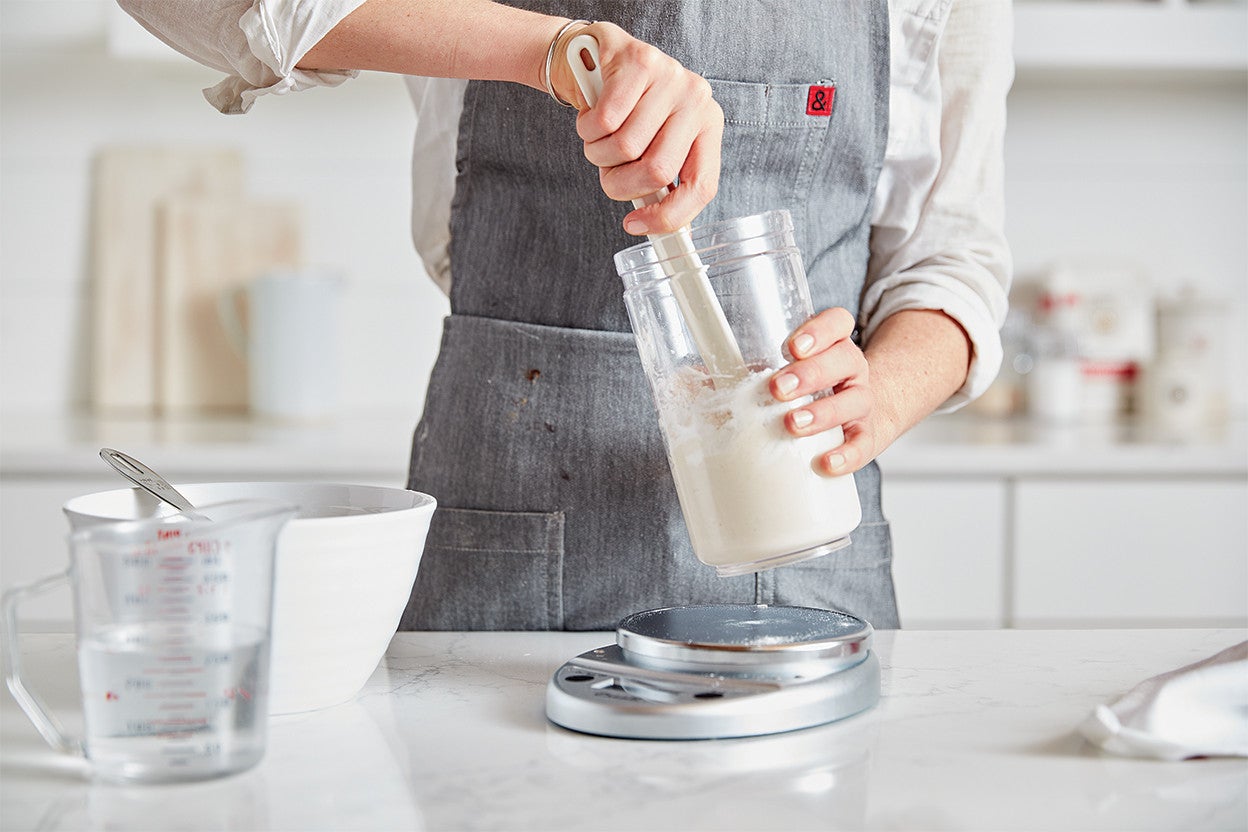
  6. Day 3: By the third day, you'll likely see some activity — bubbling; a fresh, fruity aroma, and some evidence of expansion. It's now time to begin two feedings daily, as evenly spaced as your schedule allows (e.g. feeding your starter first thing in the morning and before bed). For each feeding, transfer the starter to a bowl so that you begin with an empty container. Measure 50g (scant 1/4 cup) starter into the container. Discard any remaining starter. To the container with the starter, add 50g (generous 6 tablespoons) all-purpose flour, and 50g (scant 1/4 cup) water. Mix well and cover; this completes a standard “maintenance feeding.” Let the mixture rest at room temperature for approximately 12 hours before repeating this process.

  7. Day 4: Repeat the discarding and feeding process outlined in step 6: Feed the starter twice more, spaced about 12 hours apart (morning and evening).

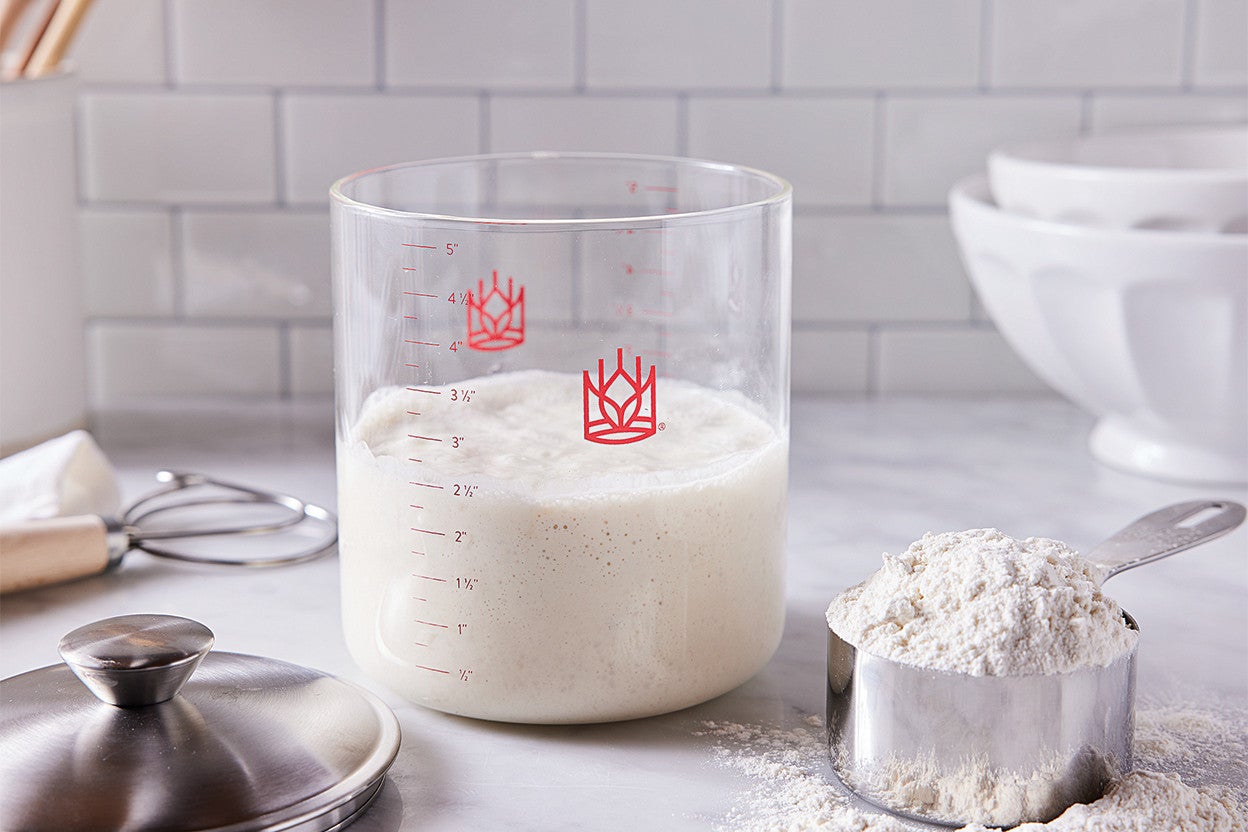
  8. Day 5: Repeat the discarding and feeding process outlined in step 6: Feed the starter twice more, spaced about 12 hours apart (morning and evening). By the end of day five, the starter should at least double in volume in about 6 to 8 hours. You should see lots of bubbles throughout the mixture; there may be some little "rivulets" on the surface, full of finer bubbles. Also, the starter should have a tangy aroma — pleasingly acidic, but not overpowering. If your starter has all of these qualities, it’s ready for baking! If your starter hasn't risen much and isn't showing lots of bubbles, repeat discarding and feeding every 12 hours on day six, and day seven, if necessary — as long as it takes to create a vigorous (risen, bubbly) starter.

  9. Once your starter is reliably doubling in size after each feeding, then it is healthy, active, and ready to move onto maintenance mode. See our recipe Feeding and Maintaining a Sourdough Starter for detailed instructions on how to keep a starter at room temperature with daily feedings or in the refrigerator with weekly feedings.


Tips from our Bakers

  • Why do you need to discard sourdough starter? It seems so wasteful... But unless you discard starter at some point, eventually you'll end up with a very large container of starter. Also, keeping the total volume of starter down offers the yeast more food to eat each time you feed it; it's not fighting with quite so many other little yeast cells to get enough to eat. You don't have to actually discard the starter if you don't want to, either; you can give it to a friend, or use it to bake. There are quite a few recipes on our site using "discard" starter, including pizza crust, pretzels, waffles, and even chocolate cake. If you're still uncomfortable dealing with discard, though, try maintaining an even smaller starter: the smaller the starter, the smaller the amount of discard. 

  • Why does this sourdough starter begin with whole grain flour? Because the wild yeast that gives sourdough starter its life is more likely to be found in the mineral-rich environment of a whole grain flour than in all-purpose flour. What if all you have is all-purpose flour, no whole wheat? Go ahead and use all-purpose; you may find the starter simply takes a little longer to get going. Also, if you feed your starter on a long-term basis with anything other than the all-purpose flour called for here, it will probably look different (thicker or thinner, a different color) and act differently as well. Not to say you can't feed your starter with other grain-based flours; just that the results may not be what you expect.

  • Want to put your starter on hold for the summer, or as you go on vacation? Here's how: Drying your sourdough starter.

  • Should you use bottled water? Unless your tap water is so heavily treated that you can smell the chemicals, there's no need to use bottled water; tap water is fine.
  • A note about room temperature: the colder the environment, the more slowly your starter will grow. If the normal temperature in your home is below 68°F, we suggest finding a smaller, warmer spot to develop your starter. (To give your starter the ideal rising environment, keep it in a Sourdough Home.) Or you can try setting the starter atop your water heater, refrigerator, or another appliance that might generate ambient heat. Your turned-off oven, with the light turned on, is also a good choice. Wherever you place it, just be sure to monitor the temperature of your starter periodically to make sure it’s not getting too hot; remember that ideal range is 70°F to 78°F.