-
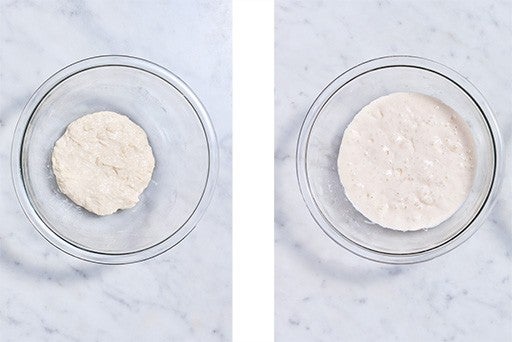
The night before you plan to bake: In a medium bowl, mix the levain ingredients until well combined. Cover and set aside at cool room temperature (ideally 70°F or less) for 8 to 10 hours, until bubbly throughout and at least doubled in size. If your house is very warm, make the levain the same day: Mix it first thing in the morning using lukewarm water (80°F to 90°F).
-
The next day: In the bowl of a stand mixer fitted with the flat beater or in a large bowl, combine the levain and water. Weigh your flour; or measure it by gently spooning it into a cup, then sweeping off any excess. Add the flour to the mixing bowl and mix on low speed until all the flour is moistened. If mixing by hand, use a bowl scraper to fold and chop the dough, incorporating the flour as you work. Cover the bowl and let the dough rest for 20 to 40 minutes.
-
After the rest, switch to the dough hook. Add the salt and coarse ground pepper and knead for 3 minutes on low speed. Alternatively, if kneading by hand, work in the salt and pepper and knead the dough for about 4 to 5 minutes, still in the bowl.
-
If working in a mixer, add the cheese and cheese powder and continue to knead for 1 to 2 minutes, then increase the speed and mix until the cheese is fully incorporated.
If working by hand, transfer the dough to a work surface,spread it out into a recangle, and sprinkle all the cheese and cheese powder over the top. With the heel of your hand, force the dough to accept all the cheese. Continue to knead and work the dough, using a bench knife or dough scraper for help as necessary, until all of the cheese is incorporated. This will take up to 5 minutes.
-
Shape the dough into a ball and place it in a greased bowl. Cover the bowl with plastic wrap or a lid. (Note: The dough will now rise for 3 1/2 to 4 hours, during which you’ll fold the dough three times.)
-
Allow the dough to rise for 1 hour in a warm spot (ideally between 75°F and 78°F).
-
Perform a bowl fold: Grab a section of dough from one side of the bowl, then lift it up and press it into the center; repeat this several times until you’ve circled the bowl. Turn the dough over so that smooth-side is up, then remove any protruding hunks of cheese and stick them on the bottom of the dough. Allow the dough to rise for 1 hour.
-
Perform a second bowl fold: Turn the dough over so that the smooth-side is down, then repeat the folding motions, once again moving any protruding hunks of cheese to the interior of the dough. (The idea here is for most of the cheese hunks to end up in the middle of the loaf, with the top surface fairly clear by the time you get to shaping. Some cheese on top is fine, but it will be easier to score if there isn’t a ton of cheese on top.)
-
Allow the dough to rise for another 1 1/2 to 2 hours, until the dough is puffy (though not necessarily doubled in size).
-
Transfer the dough to a lightly floured surface, smooth-side down. Fold the dough once more by bringing the edges toward the center. Shape the dough into a taut bâtard. (See our blog post, “How to shape a bâtard” for tips.)
-
Lightly dust one cloth-lined 11" oval brotform with flour. (This large loaf can also fit into a 12" to 13" long brotform, or one 9" round brotform; see “tips,” below for other choices for brotforms and baking vessels.)
-
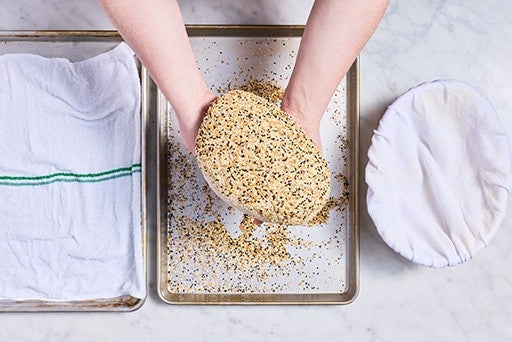
To add the topping: Spread the bread topping on a rimmed baking sheet or piece of parchment. Wet a clean kitchen towel, then wring it out; it should still be pretty damp. Roll the top and sides of the shaped dough over the towel to moisten the loaf, then through the seeds to coat. Transfer the loaf seam-side up to the brotform, then cover.
-
Allow the dough to rise at room temperature for 2 to 2 1/2 hours, until the dough feels light; a gentle poke with a floured finger will result in the indentation filling in slowly. Alternatively, refrigerate the covered brotform for 10 to 24 hours. (If the dough felt sluggish during the initial rise, allow it to sit at room temperature for up to 1 hour before refrigerating.)
-
To bake: At least 1 hour before baking, preheat the oven to 475°F with a baking steel or stone on the center rack and, if adding steam, a cast iron skillet on the rack below. If your dough has been refrigerated, let it rest at room temperature for about 30 minutes while the oven preheats. Gently transfer the loaf from the brotform onto a sheet of greased parchment (greasing the parchment prevents any melted cheese from sticking). Score the top of the loaf several times with a lame.
-
Using a baker’s peel or an inverted baking sheet, load the loaf, still on the parchment, onto the hot steel and immediately cover with a baking shell or pour about 1 cup (227g) warm water into the cast iron skillet.
-
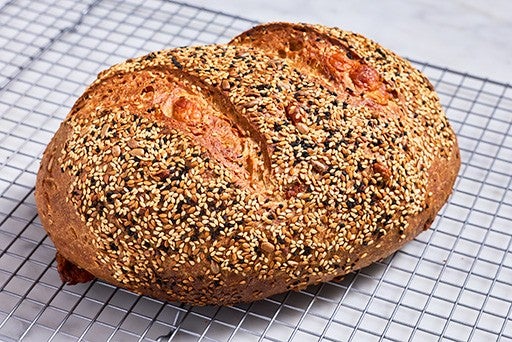
Quickly close the oven and immediately reduce the temperature to 425°F. Bake the loaf for 40 to 45 minutes, removing the shell after the first 20 minutes, if using. The loaf should be a rich, reddish-brown color when done.
-
Remove the bread from the oven, transfer to a cooling rack, and allow it to cool completely before slicing.
-
Storage information: After the first 24 hours, store the bread securely in a plastic bag, where it will stay moist for several days. For longer storage, wrap in double plastic as airtight as possible and store in the freezer. Thawed bread can be made refreshed in a 350°F oven for about 10 minutes.