



The secret to make-ahead pie crust? Pie crumbs.
Get ahead on your pie baking right now.

Date
October 26, 2026


'Tis the season — to start thinking about holiday baking. And while this time of year is full of joy and celebration, it can also be stressful. We’re all searching for ways to get ahead of the curve, and one of the easiest? Make-ahead pie crust, made using pie crumbs.
I first learned of this technique from a 90-something friend with whom I love to talk baking. Over lunch one day, something she said about pie captured my attention.
"Did you ever hear of pie crumbs?" she asked. I admitted I hadn't — aside from the obvious: the scraps of pie crust left on the plate after the slice is gone. "My mother used to mix flour and salt and lard together to make this crumbly mixture that she'd store in a crock in the cellar. She called them her pie crumbs. When she wanted to make a pie, she'd just scoop out a few handfuls, add water, and roll out her crust."
Sounds like a good make-ahead solution for 100 years ago — but now that we have easy access to freezers, why not just make pie dough and freeze it in ready-to-roll disks? A couple of reasons, actually.

1) Pie crumbs allow you to make any amount of crust, from mini apple pies to a crust for a deep-dish 10" pie. With frozen disks, you're looking at a standard single crust — not always exactly what you want.
2) Pie crumbs save time. Remove however much of the crumbly mixture you need (more on this below) from the freezer, and within 15 minutes the fat is soft enough that you can add water and roll out your crust. Compare that to the hours it takes to thaw and roll a frozen disk of prepared crust — not to mention the elbow grease if your crust isn’t fully thawed.
3) Pie crumbs can be more stable in the freezer than pie crust disks. Why? Because without the added water, no ice crystals form. Ice crystals can damage the flour/water matrix, leading to changes in its structure (which can then potentially lead to changes in your pie crust).
Oh, and one other reason I like pie crumbs: If my friend's mother used them, they were probably a 19th-century kitchen time-saver. And I love the feeling of preserving and carrying forward our American baking traditions — even something as simple as a shortcut for pie crust.
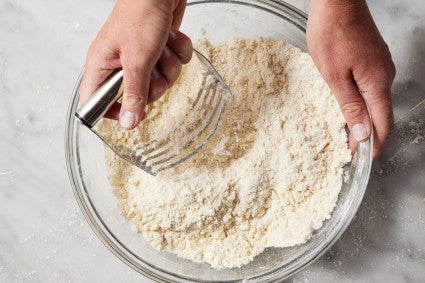
Choose a standard pie crust recipe: Our Classic Double Pie Crust recipe is good choice, but anything that involves cutting fat into flour (lard, shortening, butter, etc.) will work.
Mix flour, salt, and shortening and/or butter: Follow your recipe up until all of the fat is incorporated into the flour. You should be left with a bowl of dry, crumbly dough that barely holds together when squeezed. If using butter, you should be able to see visible chunks scattered throughout the dough.
Weigh the pie crumbs: If you’re making a large batch of pie crumbs, it’s helpful to weigh and label the total gram amount so that you can easily remove the amount of pie crumbs for a single pie crust as needed. Our Classic Double Pie Crust makes 488 grams of pie crumbs; that means 244 grams per single pie crust. Label these amounts on your freezer storage bag.
Bag, label, and freeze the crumbs: Seal pie crumbs in an airtight, freezer-safe bag and place in the freezer, preferably in the back where it won't be subject to warm air wafting over it each time you open the freezer door.
Scoop crumbs out of the bag into a bowl: Whether one crust, two crusts, or one and a half, do the math and measure the crumbs based on your recorded gram amounts.
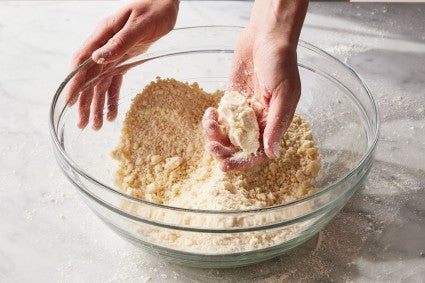
Let the crumbs thaw for 15 to 20 minutes or so: Wait until the butter chunks feel barely pliable in your fingers.


Add water and mix: Add water based on your original recipe amount, or just enough water to make a chunky mass when mixed. Squeeze and knead the dough briefly; all you're doing here is bringing the chunks together into one solid piece of dough.
Roll the dough, place in a pan, and bake accordingly: From here, your pie crust is the same as any fresh-made crust and can be filled and baked or prebaked for a no-bake filling. (Bonus: Because the crumbs were frozen and remain cold as you work with them, there's no need to chill your rolled-out crust before filling and/or baking.)
Fairly indefinitely, though the longer they're frozen, the more chance they have both to absorb freezer odors, and for the fats to start to go off. I've also found that, after about two weeks in the freezer, I need to add a touch more water than usual to bring the dough together — due to the drying effects inherent in freezing.
With pie season hard upon us, now's the time to try pie crumbs for make-ahead pie crust. Or maybe you have another old-fashioned pie trick up your sleeve? Share your favorite tips in the comments, below.
For detailed ingredient amounts for the crust demonstrated above, see our recipe for Classic Double Pie Crust.
And if you're looking for additional time-saving ways to use your freezer in the run-up to the holidays, check out our recipe for Homemade Brown and Serve Rolls and Apple Pie with Make-Ahead Filling.
Cover photo and food styling by Liz Neily.