



Pizza steel vs. stone: What’s best for making pizza?
How to get the crispiest pizza crust.

Date
July 17, 2026



This article is excerpted and adapted from The Book of Pizza.
If pizza is all about the crust — and it’s our position that the quality of the crust is what differentiates a bad pizza from a good one — then getting the crust to the right color and crispness is a pizza baker’s highest priority. That’s where pizza steels and stones come in.
Steels and stones (sometimes called a “baking steel” or “baking stone”) are slabs of material that have exceptional thermal mass, which is another way of saying they get very hot — and stay that way. These slabs also conduct and transfer heat well, which is the point of using them: When the heat from the steel or stone transfers to the bottom of your pizza, it gives the bottom (or “undercarriage,” as the pros say) of the pie great color, gets it maximally crispy, helps the dough rise high, and overall gets it as close to a pizza shop pie as possible.
In short, if you want to make great pizza, a pizza steel or stone is key. (Sheet pans are the alternative to pizza steels and stones, but, really, they’re a poor substitute — they’re too thin to produce a good crust.)
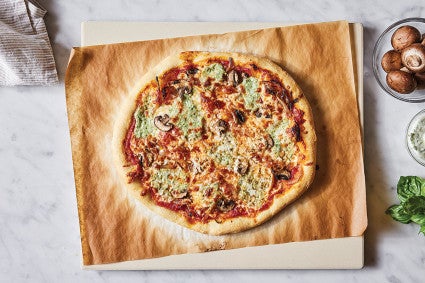
Both stones and steels work well, but if you can choose, go for a steel — they simply get hot faster and transfer heat better.
Stones (which are often not actually made of stone, but rather a ceramic called cordierite) don’t transfer the heat as well as metal steels, which have higher thermal conductivity. This means that in addition to holding heat well, a steel also transfers it to the pizza more quickly, translating to faster cooking, better browning, and crispier crusts. Stones can also deteriorate and crack, whereas steels (which are literally slabs of steel with sanded edges) are pretty much indestructible.
Whichever you choose, get a pizza steel or stone that is rectangular (not circular) and as big as can fit in your oven — rectangular slabs are more versatile than round ones (great for making bread!), and the bigger your stone, the easier it is to slide your pizza onto it.
Watch Martin test bake pizza on a stone, a steel, and a sheet pan:
Both steels and stones need to be thoroughly preheated, or else they’re pretty much useless. We recommend preheating your oven, steel or stone in place, for at least an hour before baking a pizza; if you have an infrared thermometer, look for the steel or stone to be at least 500°F. To speed up preheating, consider using the convection functionality if your oven has it.
Whenever possible, give the steel or stone at least five minutes to recover and reabsorb heat in between pizzas. If you don’t, you’ll notice diminishing returns: Each pizza will be paler and less crisp than the last. Some bakers put two steels or stones in their ovens for specifically this reason; they alternate which steel or stone they use, which gives the empty steel or stone time to thoroughly reheat.
Pizzas can be baked directly on steels or stones, or you can add a layer of parchment between dough and stone. Pan pizzas also benefit from being baked on steels and stones, but not if you’re using a glass pan. (Note: you shouldn’t be using a glass pan for pizza anyway.)
And steels and stones aren't just for pizza, either. Bake your pies like pizza, too — a stone or steel is a great way to ensure a fully browned pie crust and prevent a soggy bottom.

Cover photo by Rick Holbrook; food styling by Kaitlin Wayne.