









My kids and I are big fans of the television show “MythBusters,” where the hosts use science to prove or disprove myths, such as: Can a pressurized can of refrigerated biscuit dough explode in a hot car? And what really happens when you mix Pop Rocks and soda?
Following in their footsteps, I’m here to answer a common baking question: Does salt kill yeast?
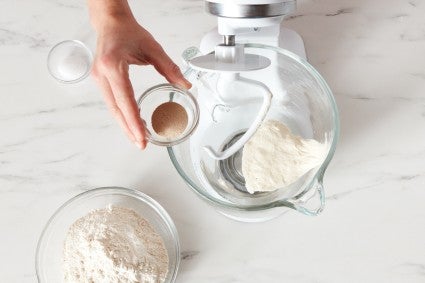
If you’ve done some bread baking, you’ve probably encountered a warning about how you should never let salt and yeast come in direct contact because “salt kills yeast.” But is it true?
Salt is hygroscopic, meaning it readily absorbs water from its surroundings. If a large amount of salt (or sugar, which is also hygroscopic) were to be combined with a small amount of yeast and left for a long time it could, in theory, eventually rob the yeast of water to the degree that the yeast cells would begin to die off. Director of Research & Development Sue Gray explains, “If you added a large amount of salt, say a tablespoon, to a 1/4 teaspoon of yeast and let that sit for a while it could have a negative effect, but not in the concentrations we use in baking.” In most recipes, salt represents 2% of the total mix (based on flour weight), a low enough percentage that it would never kill the yeast present in the dough. Plus, they’re not going to be in direct contact for long; usually, it’s just a few minutes between combining ingredients and mixing your dough.
So, while it’s theoretically possible for salt to kill yeast, practically speaking it’s not a concern; you can let them touch without any negative effects.
That’s not to say that salt has no effect on yeast at all; it certainly does. Salt acts as a yeast inhibitor, slowing growth and reproduction of yeast in bread dough. That might sound detrimental, but it’s actually desirable, helping keep the yeast growth in check so your dough ferments at a controlled rate. (The presence of salt also positively contributes to yeast dough by strengthening its gluten network and aiding with crust browning — read more about this in our blog, Why is salt important in yeast bread?)
What’s more, adding hygroscopic salt (or sugar) to yeast doughs prompts the yeast cells to release some of their water through their cell walls, causing them to dehydrate and shrink. This osmotic shock to the yeast cells results in a brief “lag phase” where the yeast doesn’t do much of anything. But the yeast can handle this shock, recovering quickly and entering the “expansion phase” where it begins to produce carbon dioxide that causes dough to rise.
Ultimately, if you’ve waited for a bit and your dough isn’t rising and you think your yeast is dead, don’t blame the salt: Yeast can lose its effectiveness if it’s improperly stored, or if it’s combined with water that’s too hot (over 139°F).
But the main takeaway here: In any normal, practical scenario where a baker would be combining yeast and salt, there is no chance that allowing the two to touch — or mixing them together — would cause the yeast to die. This myth? Busted.
Ready to do some yeast baking? Stock up now.
Cover photo (Light Rye Bread) by Rick Holbrook; food styling by Kaitlin Wayne.