




Eggs are the Party Animals of Baking, with Nicola Lamb
What do cakes, cookies, brownies, blondies, and more have in common? They’re all made with eggs, one of the true backbones of baking.
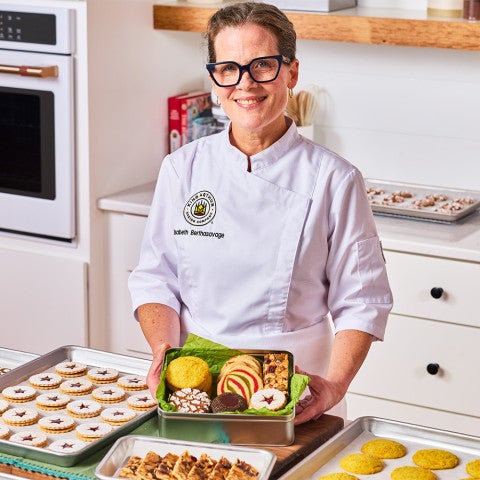
Today on the show, we’re celebrating the humble egg. Jessica and David each nominate their eggiest bakes before David sits down with cookbook author (and egg enthusiast) Nicola Lamb to talk more about the important role this versatile ingredient plays in all kinds of baking. Jessica and David then dive into your egg questions, covering meringue myths, egg sizes, and more. Jessica shares an egg-y Jess-opinion, and they close out the show with the recipes they’re baking this week.
Recipes and other links from this episode:
- Read more about why we recommend folding eggs whites with a whisk
- Find David’s eggiest bake, Traditional Angel Food Cake
- Subscribe to Nicola’s wonderful Substack, Kitchen Projects, and learn more about her book, SIFT
- Learn more about our Grains for Good program
- Read our blog post on the best egg replacements
- Learn more about how to freeze eggs for baking
- Check out our blog on the best way to crack eggs
- Find our Ingredient Weight Chart for egg weights (and much more)
- What David’s baking this week: Cinnamon-Sugar Crunch Bagels (part of our Fall Flavor Edit!)
- What Jessica’s baking this week: Whipped Cream Dream Cake
- Record your question for our Ask the Bakers segment here!
- Follow along with us on Substack
- For 25% off any On-Demand baking class, use coupon code POD25 at shop.kingarthurbaking.com/on-demand-classes
Episode Transcript
- Have you discussed this with your therapist? Has this come up yet or is this just a new-
- We're in therapy right now.
- Yeah, we are.
- I'm discussing it with my therapist right now. What are you talking about?
- From King Arthur Baking Company, this is "Things Bakers Know." I'm Jessica Battilana, employee-owner at King Arthur Baking.
- And I'm David Tamarkin, employee-owner at King Arthur. And today we're talking about an ingredient that's integral to so much baking, the egg.
- A surprisingly controversial topic.
- So many of the topics we talk about on this podcast are surprisingly controversial.
- Or maybe we just find the controversy in everything. We seek it out.
- We seek out the baking controversy.
- We do.
- But eggs are not controversial because of their role in baking. They're more controversial because of their nutrition. I can't keep track of it, like, in my lifetime, which is, you know, yes, listeners, it's been a long one, eggs have gone from completely vilified to, you know, nature's hero, and I have no idea where we are right now.
- Do you remember that ad when we were kids for the incredible edible egg?
- Yes, of course I do.
- I mean, that has really lodged in my brain.
- Till you just can't anymore, yes.
- But where does the egg stand right now?
- I think the last thing I heard was that they're okay, but we're supposed to limit to one a day.
- One a day? Uh-oh, I'm screwed.
- I'm screwed too. I've already had three. What time is it? It's 10:06 AM, I've had three eggs already.
- Yeah, I mean--
- I just got to get that protein, baby.
- I also just feel like eggs are, you know, they're like the warm blanket of the pantry. You know, you have them in your fridge, so many uses, including just having a fried egg for dinner. But so many things that the eggs can do in baking and not in baking. You know, but when I can't think of something to make, I'm like, "We'll have an egg."
- Yeah, if there are no eggs in the fridge, I truly feel lost. I run screaming to the bodega. This is another great thing about New York, eggs on every corner. I mean, you know? For only $12 a dozen.
- I know, right? Well, I have the country equivalent of that, which is there's a woman a few houses down that has a little stand at the end of her driveway. They're $4, no, they went up. They're $5 a dozen now.
- Oh, wow.
- I mean, I guess they could be called pastured backyard chickens. Beautiful. All the colors, all the fancy breeds.
- It'd be cheaper for me to drive to Maine and get my egg from this woman and then drive back.
- I mean, and happily, we don't have to weigh in on this podcast about, you know, the health of the egg.
- No, we don't have to, and we won't.
- We won't. We're just gonna boost.
- I think it's already clear to listeners that we are pro.
- Yeah, we're pro.
- We're pro. We're biased. We like eggs.
- Yeah, we don't like to tell anyone what they can and cannot eat.
- Except flour.
- Except flour. Everyone has to have lots and lots and lots of flour.
- Not raw. Baked.
- Baked flour.
- I guess we're not supposed to eat raw eggs either. That's a whole other thing, we're not gonna get into it.
- We're not gonna get into that.
- What are we gonna get into, Jessica?
- We're gonna get into... Well, I think before we talk about the role of eggs in baking, it's useful to think about the makeup of an egg.
- Yeah.
- I mean, I guess it is the nutritional breakdown of the egg, but I'm not so concerned with the nutrition part of it. I just want to talk about why it's such a powerhouse ingredient in baking. I mean, they are incredible and edible.
- There's so much baking that's very dependent on it.
- They do a lot So an egg is 75% water, 13% protein, 10% fat, which, I mean, is basically how I describe my own makeup.
- Oh, you're hydrated.
- Yeah. No, that's not true. As anyone who works with me knows, that is not true. The white holds more water than the yolk, and the yolk holds all of the fat. And the yolk also has lecithin, which is an emulsifier that attracts fat and water, which is why you see eggs as the base of lots of emulsified things, including the most famous and controversially the most delicious, mayonnaise.
- Oh, okay. I was waiting to see where you would go with that. Yes, mayonnaise also, emulsification is key in things like puddings to what makes puddings smooth. And it's also what keeps cake batters from separating.
- And we were talking about that in a previous episode. You know, somebody was asking about why you alternate liquid ingredients with dry ingredients and you know, we're describing that curdling that can happen when you get that imbalance of fat and water. So the egg is doing a lot of heavy lifting, and it can be used in so many different ways, right? It can provide lift to baked goods. I mean, even, of course, the ones that are more obvious, like the ones that include beaten egg whites, you know, that get folded in to give it loft, but also it's doing work even in a creamed cookie. It's still giving that lift.
- Talk about that though, because it's the whites that are doing the lifting, right?
- Yes, exactly. So when you whip egg whites, they hold air. And then when you fold those egg whites into a batter, you're essentially folding in air. And that's true of like a cake that has beaten egg whites in it. In the case of a creamed cookie, you're still beating in air when you're creaming the butter and sugar, but you're not beating the egg whites separately. So that's a different animal, but they're still like contributing the lift of the cookie overall in addition to chemical leaveners, but not in the same way like a chiffon cake does where it's really relying on the air that you capture in those beaten egg whites to do all the lifting in your cake, which is why those cakes can be kind of stressful to make.
- Right, it's why we make such a big deal about saying, be gentle when you're folding those beaten egg whites in because, yes, they're holding air, but it's also very easy to knock the air out of those egg whites.
- Well, and I do think, and this is maybe more granular than we need to get at this exact point in the episode, but a tip I learned from our former test kitchen director was to start folding in egg whites using a whisk, not like a flexible rubber spatula, and then to transition. So the first initial, say you're adding your egg whites in three additions, you do that first one with the whisk, so you sort of kick it off and lighten the batter, and then it's easier to fold in the other two. And that was actually a real game changer. But I do think gentleness is key.
- Yeah. We sort of lost the thread though for me, Jessica, because you were talking so much about, you know, the science of the egg, but the most important question I want to ask you is, how do you like your eggs in the morning?
- Oh, that's a good question.
- People want to know.
- I like a poached egg.
- Okay. And you're doing that on a regular basis?
- I do. I do it on a regular basis. I do not put vinegar in the water because that is disgusting.
- Oh, because you don't want the flavor of the vinegar?
- No, I don't want them to taste like vinegar. And I've trained my children now too. I mean, now they're these people. Like, we go to a diner and they're like, "Do you poach your eggs with vinegar in the water?" And then they won't order them if they do.
- Oh, wow. Gosh.
- So I just salt them. I don't know why people make such a big deal, honestly, about poached eggs. Like, they're not hard to make.
- I was not prepared for you to get so up in arms about your egg.
- I know. I don't know. I'm just like on the offensive, defending the poached egg.
- I think people get up in arms because they want a really tight, like, really beautifully shaped poached egg, which you got to kind of learn how to do that. But are your eggs, do you care about--
- I don't care that much. I know some people take their egg and they strain it through a spoon to let the loose white.
- It's wasteful.
- It's wasteful.
- Yeah, right.
- I don't mind if they don't look picture perfect. So I just put them, you know, salted water, little vortex, drop them in there. But my teenagers now are like, "Can I have four poached eggs?" They would each like four poached eggs, which really turns you into a Vegas breakfast--
- The nutrition scientists out there freaking out.
- I know. Because you can't make, I mean, I have two children, so it's like they want eight eggs, and then I'm trying to get one in the pan for myself. It's really turning into a thing.
- That's why I think boiling is the way to go, or steaming.
- Yeah. So what's your go-to egg preparation is?
- I mean, my favorite eggs are soft scramble on toast, lots of butter.
- Interesting.
- Maybe some chives on top. But I think my most common eggs is, I will boil 10, 12 eggs at a time or steam them, which I prefer actually just to have in the fridge for whenever I'm-
- Yeah, an insurance egg.
- you know, desperate, yeah. But I think a soft boiled egg, it's a decent substitute for a poached egg.
- Yeah, I think so. A lot of talk these days about jammy eggs.
- Yeah.
- Lot of talk.
- Yeah, nobody wants the hard boiled egg anymore with the pale center. That's so out.
- It's so out.
- People think it's wrong.
- I love a just straight-up hard boiled egg.
- Oh, yeah, I like it when it has that green ring around it. Give it to me, you know? Anyway, we can get back to baking now. This egg conversation could really take us anywhere. Cakes, cookies, plenty of breads, even some tarts, but we're gonna try to stick to the eggiest bakes in this episode. Another question for you, what are the eggy bakes? I'm gonna nominate one myself. It's gonna shock you, angel food cake.
- Oh, yeah.
- I think it's an eggy bake.
- Yeah, it is.
- And it's because of what we were just talking about before. It's so dependent on whipped egg whites, you know, holding all that air because, if I'm not mistaken, that's the only leavening in an angel food cake.
- Egg whites, sugar, and like a nominal amount of flour.
- Yeah, and classically, there's no fat in an angel food cake, so that's why the yolk isn't there.
- And that's why it was so popular in the '80s, you know?
- Do you love angel food cake?
- I love it. I love it. And I made it recently for a dinner party because I was like, "Oh, angel food cake." And I have to say, it wasn't received as well as I though it would be.
- Yeah, people think they don't like it.
- It's like eating cotton candy when it's good. I'm gonna nominate as the eggiest bake, I don't know, I mean, it's on my mind because we've been working on it for our forthcoming cookbook, but crème caramel--
- It's basically scrambled eggs.
- Well, hopefully it's not scrambled eggs, but yeah, it's basically all egg, right?
- Yeah.
- And cream or milk?
- Cream, milk, eggs. But it was interesting to sort of mess around with the ratio of egg yolks, which we talked about being all fat, to whole eggs, which have the water, the fat, because you do want to get that ratio right because you know, more yolks gives you sort of a richer custard. You think about an ice cream custard base, which is all yolks and dairy. But also you need some of the structure that a whole egg adds to that because that's one of the most amazing properties of an egg, is its ability to coagulate things, right? But you got to get that sweet spot, not only the sweet spot of like the amount of yolks to whole eggs, but also how you cook a custard because, you know, you were saying you like a soft scrambled egg and it's very easy to take a custard, like, to overcook a custard, and then it's revolting.
- It's not cute, yeah.
- It coagulates and it's like scrambled eggs.
- And it's the proteins in the egg that are coagulating right, and getting tough.
- Yeah, but I think all of those custard sort of things are probably contenders for, like, A, the most delicious.
- Absolutely, yeah.
- And also, I just want to give an honorable mention to, I said before we started recording, but like, what about Île flottante, which I think is a lovely dessert.
- Never heard of it.
- So it's meringues.
- We didn't all go to cooking school in France, okay?
- Sorry, sorry.
- I'm from Ohio.
- I actually--
- Île flottante?
- Île flottante.
- It sounds like seafood.
- Floating island.
- Okay. Oh, floating island. You should have said floating island. Now I know what that is.
- Now you know what it is. Wait, wait, let me see. I think I know what it is. It's meringue that's set in like a crème anglaise or pastry cream or something?
- Yeah, it's poached. Like, they're poached in milk, on top of milk.
- The meringues are poached in milk?
- Yes.
- Oh, you just really love the poaching.
- I guess so, yeah. If there's an egg near me, I'm gonna poach it.
- Even if it's a whipped egg white.
- Even if it's a whipped egg white. But that's sort of a fun technique. And then it showcases the egg in two ways. You have the whipped whites forming the meringue part, and then the crème anglaise, it's all yolks, you know?
- crème anglaise with a sauce.
- People don't know, or some people may not know, crème anglaise is just ice cream.
- It's just ice cream.
- And if you truly people, truly, I'm looking at the camera now, watch this on YouTube, if you need crème anglaise, just buy some Haagen-Dazs cream and just--
- Melt it down.
- Melt it down. Pour it on that plate.
- I feel like crème anglaise and angel food cake are both due for a comeback.
- I would like to have them together. So what I was about to say, what I was gonna say about the angel food cake, I'm not necessarily with your guest. I never reach for it, but when I have it, I enjoy it. But I do think it needs something rich to counter. I want some fat there. So like some crème anglaise, or I don't know, I like it with macerated fruit too.
- My mother used to drizzle Hershey's syrup over it.
- Well, I was about to say like hot fudge.
- I mean, Hershey's syrup is not right, but yeah.
- But some people do a hot fudge with angel food cake is something-
- That's a thing.
- you know, it's because you want that rich fatty element to offset it, yeah.
- I know we've dipped our toe into the science of the egg, but today's guest, she's dipped her whole body.
- We're letting her do the heavy lifting.
- Yeah, we are. And smart. You know, we're getting smarter about this.
- Yeah, right. Because we want to do these nerdy topics, but we're not nerdy enough. So we got to bring on the real nerds.
- I mean, we're nerdy in the wrong ways.
- All the wrong ways, yeah. So we invited one of the world's most rigorous and science-minded bakers, Nicola Lamb, on the show today to talk nerdy to us about eggs. I don't think she needs an introduction to our listeners, but I'll give it anyway. She's the author of the bestselling cookbook "SIFT," which was a sensation in the UK where Nicola is based. Also here in America. It won, I think, every award. I think it won the Academy Award for Best Picture. And she's the writer of the newsletter that gets our team here at King Arthur fired up every week called "Kitchen Projects." I swear, every time this newsletter comes through, the chat or, you know, our work chat blows up like, "Did you see this? Did you see this?" Just the amount of testing that she does is just unreal.
- It's amazing.
- And you know, it just kind of reminds me of you, Jessica, because you also have this quality about you where you're not afraid of work. You get in there, you do this, you just like do your thing, where I'm like, "I'm not doing that."
- Yeah, she leaves no stone unturned. And I think she has a lot to teach us about the egg.
- Yeah, and she's just a lovely person, so.
- All right. Well, let's hear her.
- Nicola Lamb, thank you so much for coming on "Things Bakers Know." It's beyond a pleasure to have you because as I said earlier in the show, you're like a celebrity to us here at King Arthur, so thank you for coming.
- I'm so honored to be here. I have had a long relationship with King Arthur and King Arthur Baking. It's taught me so much over the years, so thank you right back.
- Oh, well, I think there's a lot of synergy between what you do and what we do because there's a real educational component to all of your work, which is one reason why we love it. And "SIFT," I have the pink American copy here, is really, and I say this with love, is almost like a textbook in the beginning. And the egg chapter is one of the biggest chapters. And it's so fun to dig into this chapter and to understand why it would get so much prime placement in the book because it's so important to baking. And I want to get into the science of it because you explain it so well. One of the primary purposes of eggs in baking is coagulation, which is the process of an egg's protein going from a liquid to a solid state. And you have a really fun analogy in the book that likens proteins to guests at a party. Would you mind expanding on that for our listeners?
- I will tell you now that when I wrote "SIFT," my book, eggs was the first chapter I wrote because I had the most to say about it because it is the most fun. And I know we're probably gonna go through all of the different functions, but I wrote some down before we started. Bind, thicken, set, flavor, enrich, aerate, emulsify, hydrate, volumize, clarify, glaze, brown. And obviously, you can just eat them. And so coagulation is probably one of the main functions that we see in pastry. When I was writing it, I was thinking about how could you describe this idea of like a mass coming together? So I likened it to a conga line. So at the beginning, you know, music starts, one person stands up, that is the first protein that puts their hand out to their fellow guests and says, "Come on." And then slowly as the music takes over, as the heat rises literally in the dance floor and in the custard or in the eggs, all of these guests or these egg proteins kind of unfurl, put their arms out, join together and create this one wobbling mass. So eggs are a party to me, so I really feel that way.
- I love that because it makes it so clear to me what's happening, but I also felt seen a little bit because you described the proteins as being sort of grumpy and arms crossed at the beginning of the party and being antisocial. And I was like, "Oh, that's me. I'm an egg protein."
- Yes, they have to be encouraged.
- Yes, yes. So am I correct when I say that, when we're dealing with eggs in baking, we are often undergoing a process of trying to dial in the exact right amount of coagulation?
- Yes. So you do want your proteins to join together to create this process of something going from a liquid to a solid. If you go too far, then all of the proteins clump together. And then what's expelled is the rest of the stuff that's in the egg. The net can no longer hold what's there and it will break up into these clumps and you'll get some sort of water squeezing out. And what you'll end up with is, instead of one lovely wobbling mass, all of the egg will get together. And this net that would've been holding the sugar or the milk or the cream or whatever else you put in there with your custard has nowhere else to go because the eggs create their own gang and can no longer sort of manage to sort of hold the rest of the ingredients.
- And what about when we're making a sponge cake? Coagulation is happening there too, but we're just taking it farther. Is that correct?
- So with a cake, the eggs are so diluted that you don't have to worry about that kind of overcoagulation in such a point. It is, you know, creating some structure, but a lot of the structure is coming from starch and with flour. So I think that it's gonna be less of an issue than when the egg is the star. So whether you're doing a meringue or if you're cooking something gently or whether you are doing custard, in a cake, you can take it further probably because there's also a lot of fat that's sort of protecting the eggs from kind of going too rubbery and hard, plenty of sugar. There's a lot of defense structures almost in place to prevent that kind of negative kind of overcoagulation that you can be so worried about.
- You mentioned defenses against coagulation. And when you say that, I think that's a great way to put it. We're talking about things like fat and sugar, right, and dairy. All of those things work against coagulation. Against sounds kind of negative. I mean, it's all working towards something, but those are preventatives to overcoagulation. Is that correct?
- Totally. So yolks already have fat in them. So inherent in egg yolks is fat, which again prevents it. And I think at this point, it might be good to talk about the difference between egg whites and egg yolks because if you hard boil an egg, you open it up, think about how different the texture of the white is to the yolk. Even though it's hard-boiled, as hard as it can be, the egg yolk is still squishy, maybe crumbly, but you can still sort of squish it into a paste. And the egg white, which is basically purely proteins and liquid, that's very hard and almost shatters and you can't bend it. So I think you have to sort of imagine, and this is what I like to do when I think about baking is I imagine what would happen to that ingredient on its own if you were to just put it into the oven for the amount of time that it was baking for. So you have two eggs, you're gonna bake them in a cake for one hour. If you put those two eggs in the oven, eventually those whites are gonna go firm. And now that's actually happening in your cake. But as you say, we've got these defense systems happening. So once you whisk an egg, those yolks are already going to be stopping the white from getting so firm and so hard because of the fat and because of the lecithin, which is the emulsifier that's in the yolks. And then once you add sugar, that's also gonna interrupt. Sugar's gonna start drawing out water and it's going to start, you know, it's hydroscopic, so it's gonna sort of also prevent those proteins from heating. And then you keep physically adding things in, so dairy, fat. And that is why you need a certain amount of egg yolks. Let's say in the example of a crème anglaise, if you have, let's say, six cups of milk and you put one egg yolk in there, that's never gonna thicken. It does happen on a ratio as well. You might end up just having a few little bits of egg floating around. It wouldn't be good, but it definitely wouldn't be thick either.
- Well, let's move on to what I consider to be a real attractive form of eggs, which is the foam, you know, the aeration and foam. So this is another thing that eggs provide to baking, aeration. Can you give us a little just introduction to foams, and what are some foams that are listeners might be familiar with?
- I don't think anyone forgets or anyone forgets the glee of seeing a meringue made for the first time or making meringue in front of someone for the first time. The idea that from this snotty, sorry, horrible word, but from this gloopy, sort of transparent mess can come this stunning cloud that defies gravity. It's so strong, you know, everyone does the trick of holding it above your head. It's really exceptional. And so, what I also found quite interesting when I was thinking about writing this book is that, coagulation is not so different from aeration. The same thing is happening. You're unfurling these proteins and then you're joining them back together. When it comes to foams, you're joining them back together with the help of sugar that's supporting them and you're not applying heat until it goes into the oven. Whereas with coagulation, like a custard, you are joining them together solely by heat, but it's sort of the same thing that's happening. With coagulation, you are agitating with heat, and with aeration, you are agitating with a physical whisk, and that's breaking them apart and they're coming back together. So it's same, same but different, you know?
- Mm-hm, mm-hm. What other function of eggs would you put near the top of the list?
- So I think the hydrating and enriching is probably the thing that eggs actually do the most that we don't even think about because yes, you can split your eggs up, you can whip them, and then you can do all of these kind of magic tricks with them. They're very impressive. But often, eggs are offering the backbone to a lot of bakes and they're actually sort of the quiet heroes. I think in my book, I describe them as sort of the chorus of the West End, kind of doing the most because they are adding flavor, they're enriching, they are literally hydrating flour to conform gluten. You know, all of these things and hydrating, you know, in a cookie. And it's interesting because, in theory, you could make a chocolate chip cookie without an egg. It's mainly there for like a bit of fat, adding structure, but they're there. And why is it? Why do we include them if they're there? If we're not whipping them, if we're not, you know, doing these magic tricks of them, you sort of have to think, so what is it that they're contributing? So I do think they are the quiet hero of a lot of bakes. They're adding browning reactions, you know, egg wash is amazing. So you're kind of egg washing from within when you put an egg into your cake. You know, they add color, the joy of a beautiful yellow kind of tone in a brioche or maybe in challah or however it is. It's doing a lot. They can also clarify. But I think that that sort of unsung hero stuff, you know, they do have these amazing talents, the foaming and the setting, but they are doing a lot of other things. You know, they're binding. So I know this is a baking podcast, but you're thinking about... I think binding and coagulation's kind of different. I'm a really big fan of eggs. I don't know if you can tell, but I'm definitely like on the egg board. I should be. I'm a big fan.
- I love that idea of the egg, you know, being the secret agent and adding all this stuff. And you're right. Like, I mean, there are plenty of bakes where I'm like, "Yeah, what is it doing there?" I guess I always assume it's there for some structure, but thinking of it as a hydrator is new for me, and I love that.
- Got to lay some respect with eggs today.
- Nicola, it's a thrill to talk to you always. I mean, you're so passionate about what you do and so knowledgeable. I mean, you're really one of the best baking teachers out there, so thank you so much for coming on the podcast, and we will bring you on again.
- Please. I love this. Thank you so much.
- This episode is brought to you by our Grains for Good program. As a certified B Corp, King Arthur values people, planet, and profit, and that extends to our flour. Our Grains for Good program supports sustainable, regeneratively grown wheat that helps actively heal the planet against the effects of climate change. And please, Jessica, note that I did not stumble at all while saying the word regeneratively.
- I love our Golden Wheat Flour. Not in my pancakes, but I use it in all sorts of other things. It has all the health benefits of traditional whole wheat. You can pick up a bag of Golden Wheat Flour at the grocery store and also at kingarthurbaking.com.
- It's time for our next segment, Ask the Bakers. For Ask the Bakers, we want to hear from you. If you have a baking question for us, head to kingarthurbaking.com/podcast to record a voice message, and we may end up using it on the show. That's kingarthurbaking.com/podcast.
- And of course, if you have an egg-related baking question or really any baking question that simply cannot wait, you can always reach out to our Baker's Hotline via phone, email, or online chat. Just go to kingarthurbaking.com/bakers-hotline. That's kingarthurbaking.com/bakers.hotline or call us 855-371-2253. That's 2253 as in bake.
- You know, it's occurring to me right now that we are going to get comments and questions about how to substitute eggs, which is something we are not covering in today's episode, but that's a great question to ask the Hotline.
- We have a blog about it.
- And we have tons of information on our site about that.
- Yeah, about what the best egg replacers are. So you can search for best egg replacers, kingarthurbaking.com, a whole blog will come up.
- Is it always applesauce? That's the question. Applesauce is delicious. Always have applesauce on hand. That's all I'm gonna say. Okay.
- Should we hear our questions?
- Yeah, sure, yeah. Let's see if we can answer them.
- I have a question about making meringue. So I know it only calls for a lot of egg whites, and my frugal side hates wasting the egg yolks. So the first part is, what can I do with all those egg yolks before they go bad? And then two, can I use the carton of egg whites that you can find so I can just nix that whole egg yolk part?
- This is very relatable to me because a couple of weeks ago, I had seven egg yolks, and, you know, eggs are valuable. Egg yolks are valuable.
- Oh, yeah.
- And so I had them in the fridge and I was looking at them for a couple days. So first of all, I will say, when I have whole egg yolks left over, I'll put them in a jar and I will put a little bit of cold water over top of them so they don't develop a skin. So that's good for short-term storage. I'm talking like a day or two. And when you get into the territory of like seven egg yolks, you're not gonna just add those to your scrambled eggs. Like, it's too much. It's too intense. So I was watching them, watching them, and I was starting to get a little panicked. And then I just decided, I had no time, I decided to make a batch of ice cream because I also had some like almost rotten cream and some milk. It wasn't rotten, but it was like, and I just whipped up. I didn't plan to make ice cream, but I was like, "It's go time. I got to do it." And then once you've made the ice cream custard, like, that can sit on its own for a couple of days. So ice cream is a great choice. Any sort of custard-based thing will use egg yolks. Pastry cream, which is one of the world's most delicious substances, lemon curd.
- And pastry cream is just basically pudding?
- Is basically pudding, exactly. And lemon curd will keep for a long time, so I feel like that's a good thing if you're like, "I don't want to have to eat another dessert right away." But it's also useful to know that egg... I think everybody, well, maybe everybody doesn't know that egg whites freeze beautifully, but so do egg yolks, so you can freeze them. And I like to be a little bit smart about it because sometimes they get broken up and then you're like, "How many was it?" You think you're gonna remember. I do like to put the weight on there because then you're like, "Okay." Or you know, you could put the number of yolks, but I put the weight because I usually bake by weight. And they'll be fine in the freezer and then you can pull them out and thaw them in the fridge and use them for a future bake. But to the second part of that question--
- Well, wait, before you get there, I want to throw in my own little suggestion.
- Talk about nerdy, you could cure those egg yolks.
- Oh, yeah.
- You know? Is it nerdy? It's like very cheffy thing to do, but it's very easy, and I don't have the recipe off the top of my head necessarily, but basically, you just bury those egg yolks in salt, maybe a little sugar in there, I'm not sure, and you just wait. I think maybe it's like a week or two and then you have this cured egg yolk that you can grate over things like salad or whatever. I mean, any dish, you could grate it over roast chicken. I don't know.
- That sounds weird.
- I know, but it adds this like umami, salty punch to things.
- Be great on a pasta thing.
- Yes, a pasta is a great example.
- I mean, it is a cheffy thing, but you know, you could also freeze some and do that with a couple of them just to try. The second part of this question, they were asking about using egg whites, you know, cartons of egg whites. You know, it's a good question. Seems like an obvious thing to do, but those are pasteurized, and the pasteurization process weakens the proteins and the egg whites so that they just don't whip up as well. And there is an answer to a question you asked and many questions you did not ask.
- Right, right.
- You are welcome.
- So anyway, in short, make ice cream.
- Yeah, make ice cream.
- And don't use those pasteurized egg whites. Let's go to our next question.
- Hi, Jessica and David. First of all, I'm so glad this podcast exists. I can't imagine a better antidote for the anxiety of these times than listening for a long, long time to you both talk about baking. The question I have has to do with eggs. I'm a pretty frequent home baker. I'm good at remembering to soften my butter, but sometimes the recipe also says to bring the eggs to room temperature. And I rarely remember to take the eggs out of the fridge before I'm ready to start. So I'm wondering what effect a room temperature egg versus a fridge cold egg has on cakes and cookies. Thanks.
- So thank you for your question and for those nice words.
- Well, we just talked about it a little bit in terms of the egg whites.
- First, let's talk about why room temperature eggs are a good thing. So you mentioned egg whites are going to whip easier if they're at room temperature. And that's true for whole eggs too, you know, when you're incorporating them into something like a cake batter or cookie batter, they're just gonna get into that batter more easily. They're gonna emulsify easier and they're gonna incorporate air into the batter more efficiently. Cold eggs also, anything cold, and we've all had this experience where we kind of put something cold in an otherwise room temperature batter and all of a sudden the fat in that batter starts to act weird, it solidifies, butter will get clumpy, you'll get these weird... That's kind of like, sometimes when you get a curdling effect as well. And it's gross and it's not ideal. So room temperature eggs really do make a difference. It's very easy to take your eggs up to room temperature. Just put them in a bowl of warm water for a few minutes, 10-15 minutes.
- Still in the shell.
- Still in the shell, right, yes. Put them in the shell. And then, I will note that eggs are more fragile at room temperature and so cracking them gets a little, it's easier, but also you may get, I don't know, I find that sometimes they get more shell or something just more fragile when they're room temperature.
- Are you one of those one-handed show-off crackers?
- Sometimes.
- Oh, wow. Okay.
- When no one's looking.
- Oh, you should do it when somebody is looking.
- When someone is looking, it will go wrong every time, yeah.
- I remember reading this essay, gosh, was it in the New Yorker? And it was all about the line cooks of Las Vegas and watching them crack eggs. There was a video component to this article. It was unbelievable.
- Yeah, it's about practice. Get your egg cracking reps in and you can do it two at once.
- Yeah, again, I'm just gonna tack on an unsolicited answer to a question that has not been asked, but we talk on the blog about the best way. You know, a lot of people are in the habit of cracking the egg on the side of their bowl.
- I don't like that.
- It's gross. You shouldn't do it for a bunch of reasons like germs on the outside of the shell. But also, I mean, chances of you getting like shell bits, 10 out of 10.
- Yes, right. I mean, that is not a clean break, the cleanest break. So we have some ideas I think are about to go there. I think the cleanest break is when you knock the shell against a flat surface like your counter.
- That's typically what I do. But we did find in researching for the blog that, if you crack eggs against one another, that works really well. I don't know.
- I'm not doing that. Yeah, and to that caller, keep calling.
- Keep calling. Keep lavishing us with praise.
- We don't need questions, just the praise. You know, just keep putting in those compliments.
- Let's go to our last question.
- I would like to know how to substitute medium eggs for large eggs in most recipes. Thank you.
- I think we're gonna say the same thing.
- I mean, talk about something that I just do not bother with.
- A medium egg? You don't mess with a medium egg?
- I just don't. Well, actually, now I'm thinking about it, I was about to say, I don't worry about this at all. But actually the truth is, I do.
- You lose sleep about it every night.
- No, I don't lose sleep about it, but I do address it.
- Well, okay, so back to my farming brag, my rural brag, which is not a thing. The eggs that I get from the neighbor and the eggs that I get from the farm stand near us, they're not always, I mean, you know, they're not standardized.
- Those farmer's market eggs are very, very, they vary-
- They vary greatly.
- widely, yes.
- Which also, I mean, gives you maybe a moment of pause considering the commodity egg market because we know that the chickens are not all laying eggs that are the same size. You see it at farmer's market eggs. So because of that, sometimes there's truly a big disparity. So now I just weigh my eggs.
- Always?
- Always.
- If you see a recipe that calls for a large or medium or just always?
- I just always weigh them because a large egg, 50 grams.
- Okay, so there we go, 50 grams. So this is what I was gonna say. I was gonna say, if a recipe just calls for large or medium eggs and I have just a standard grocery store egg, I just use it. I don't really think about it. But if it calls for grams, absolutely, I will weigh my eggs always.
- And I also think if you're using one egg, you know, I'm not proposing that this person, because I would never do it. I mean, maybe I technically should recommend, like, you got to get to 50 grams. So if your medium egg's only 40 grams, you got to crack a second egg and beat it up and add it. But this is real life. And I know that this person's like, "Well, then what do I do with the rest of the egg?" Because that's what I would be saying. So if it's a little bit of a difference for one egg, but you think, say it's got seven eggs in it and you're shorting every egg by 10 grams, you got to do a little math here is all I'm saying. Then you could be like, "Okay, I'm gonna add one more medium egg."
- Yeah, what do you do with extra scrambled eggs or like, egg wash? Like, do you do anything with the egg wash?
- Yeah, I add it to scrambled eggs.
- You keep it in the fridge and you add it to the next batch? I just scramble it right there and then I have a little snack.
- Oh, interesting.
- A very, very little snack.
- Yeah.
- And my mother saw me do that once and thought it was the most ridiculous thing she'd ever seen. But I'm like, waste not want not, you know?
- Also, if you are into Japanese food at all, there's something called a ribbon egg, you know? And a ribbon egg--
- One of my favorite things.
- You like the ribbon egg?
- Oh yeah.
- Oh yeah, it's good. So that's beaten eggs with, you know, it's usually got some sugar in it. I mean, that's kind of it. Sometimes a little dash of soy sauce, but it's a very, very thin omelet. So you're doing it in a small non-stick skillet, so you beat those things together and then it's like a paper-thin omelet that you roll up and then cut into little ribbons. And you don't need very much egg for that. And that is really good. And you can put that in your ramen, like your store-bought ramen or on a salad or--
- Japan does wonderful things with eggs.
- They sure do. But yeah, so that's what I would say. I would recommend that you weigh them. Also, I get very, just this is an aside, like a pet peeve of mine. There's a cookbook that I love dearly. I'm not gonna name names. I've talked about it before on this podcast. It's a book that I love. And for whatever reason, somebody made the decision that every recipe in there should call for an extra large egg. Like, why you got to be like that?
- That's interesting.
- It's crazy. I never buy extra. I mean, you got to write for the standard and the standard is a large egg. So if for whatever reason you have bigger or smaller ones, just weigh them.
- Yeah. Well, it sounds like we've entered Jess-opinions.
- Also, I just want to say one more thing just for numbers to keep on hand. An egg white, 35 grams, and an egg yolk, 15 grams. You can find this information on our ingredient weight chart, which is a bookmarked page on our site. You don't have to commit it to memory like the geek that I am, but there you have it. News you can use or not. And we have entered the Jess-opinion stage.
- Yes, I think we have.
- It started at moment one of this--
- Minute one.
- Yeah, minute one of this record.
- Only poached eggs. Every episode, we like to check in with Jessica to see what wildly surprising and full-threaded ideas are in her head, a segment we lovingly call Jess-opinions. Jessica, give us yet another egg opinion.
- Well, I'm not a real gadget person.
- Okay.
- This is true in all aspects of my life. I don't really have many gadgets. I especially don't have many kitchen gadgets.
- You churned that ice cream yourself, right, with just you and a barrel with some salt?
- I would, but I didn't. But that does sound great. That's the ice cream maker I grew up with, the one with the rock salt.
- Oh yeah, me too. I mean, I was always told at camp that the rock salt would kill you.
- Oh, yeah.
- And so, there we go. There is the birthplace of my anxiety, being at camp five or six years old being like, "We're making this ice cream, but the rock salt would kill you." And I was like, "What if some gets in and I'm supposed to eat this ice cream now?" I didn't eat it.
- Have you discussed this with your therapist? Has this come up yet or is this just a new--
- We're in therapy right now.
- Yeah, we are.
- I'm discussing it with my therapist right now. What are you talking about?
- So I don't have many gadgets. And maybe that started when I had a really small kitchen in San Francisco, but I'm just sort of gadget-adverse. But there are so many gadgets that optimize separating an egg.
- I didn't know that.
- Oh yeah, I mean, there's all sorts of things that you can do. And just, why? Because the best way to separate eggs, in my opinion, which is what the segment's all about, is just with your hands. So I just crack an egg, I put it in my palm, clean hands, you know? I let the white drain out between my fingers.
- Clean no more.
- Clean no more. And then I transfer, because sometimes you're doing a little like, I'm doing a motion that people can't see if they're just listening to this. But between the shells where you're just sort of like trying to get it, trying not to let the edge of the shell break the yolk, that's bananas. For a while there was like a suction--
- Well, it's bananas because it's dangerous, I mean, because often when you're separating eggs, you're trying to retain the yolk, right, and not breaking. There are so many sharp edges on these eggshells and there are no sharp edges on your smooth round hands.
- Yeah, and once you get even a droplet of egg yolk into your whites, game over.
- Game over.
- They're not gonna whip up.
- Just go to bed.
- Yeah, forget it.
- And wait till the next day.
- Forget it because the fat is an enemy. I mean, this is something I should have mentioned when I answered that question that nobody asked about meringue. Even like the trace amount of fat in your bowl, a trace amount of yolk that gets in there, you're like, "Oh, it's just a droplet." Sorry, Charlie.
- People are always talking about that. You wash your bowl, make sure there's no fat in the bowl. What are people doing with their bowls? I mean, are they just spreading butter on the inside of their bowls and they're like, "This is my butter bowl"?
- Well, you should see whenever my children wash dishes, I'm putting in quotes, because they like to wash them with cold water and they don't really like to get their hands wet or soapy. So you can imagine how this goes. Like, I pull things out all the time that I'm like, it's greasy. But don't worry, if you come to dinner, I'll make sure to hand wash your dishes so you don't have to worry. But yeah, you don't need a gadget. You don't need the suction. For a while, people were showing how to suction it with like a plastic drinking, like a water bottle, like a disposable water bottle.
- Oh gosh, oh wow.
- It can sort of suck up the yolk. And I was like, "This is so much work."
- Right, yeah.
- When you have the tools you need, you know, right at your disposal.
- Right. So the Jess-opinion is, if you can use your hands to separate an egg, use your hands to separate an egg.
- Yeah, it's gonna be the best way.
- And if you have mobility issues, use a tool, but otherwise, use your hands.
- Yes, exactly.
- Yeah, I mean, personally, I think the best way to separate eggs is just to, you know, each side gets a lawyer, maybe a mediator, go to court.
- And they consciously uncouple.
- Yeah, consciously uncouple, yes. But your way also works.
- Yeah, and my way also works. Are you making an eggy bake this week?
- I'm not.
- No.
- I mean, after this, I just, I'm egged out, you know? Well, also, as we've discussed, I've already had three eggs this morning.
- Yeah, that's true, you're saving your eggs for breakfast.
- Yeah, no, I'm making bagels this week. I don't know if I've told you or if I've told listeners, the bagel shop that I love so much that was across the street from me in New York, it closed.
- Oh, that's a loss.
- So now I'm completely screwed and I need to up my bagel making. I mean, certainly there are other great bagels in New York, but they're not across the street. So I want to have my freezer packed. And I thought I'd make the Cinnamon Crunch Bagels on our site, which is a copycat recipe of the Panera Cinnamon Crunch Bagel, which I've never had--
- You've never had the Panera version?
- I've never had Panera version, but I've had our version. I wouldn't call it a classic bagel. Maybe I would even call it sacrilegious, but I don't care, it's really delicious. It's really, really fun to eat and make.
- That's a nice fall. I mean, it's cinnamon. It's fall time. It's cinnamon's time to shine.
- This is cinnamon's time, finally.
- Finally.
- Rise up, cinnamon. And it's part of our fall, it's part of the cinnamon collection that we are promoting right now. Yes, the Fall Edit.
- Yes, the Fall Edit, cinnamon edition.
- Yeap. I'm gonna make, well, this cake has eggs, but it's not a particularly, so my birthday, thanks for asking, is tomorrow. So, happy birthday to me, and where's my cake?
- Tomorrow?
- November 3rd.
- Oh, okay. Got it, yeah.
- So since you didn't provide me with a cake--
- Since we're recording this in real time, yes, this is a live recording, everyone.
- It's a live recording. Listen, my birthday's November 3rd. People feel free to, you know, send me well wishes in the comments.
- May as well just give your social security number now and you're gonna get your stolen, okay.
- And I'm on record as a coconut lover. So I was like, "Have I recommended every coconut cake on our site?" And I thought yes, but then I realized no, in fact. We have this whipped dream... No, Whipped Cream Dream Cake. And it's an interesting recipe because, with the exception of the two eggs, the fat from the yolks of the two eggs, all of the fat in the recipe, that is to say butter or oil, is replaced by whipped cream. Wow, what a texture this cake has. And it's got a fudge ripple in the middle, and then on top, coconut. It's really got a marvelous texture. And then, I mean, the cake itself has a marvelous texture, and then you get that little bit of crunch from the coconut. I also think of it, I don't know, maybe it's the fudge ripple that makes me think, "Well, this is appropriate for breakfast." And I think on your birthday when you start eating cake, I don't know, the fudge ripple kind of makes me think of a coffee cake.
- I think it definitely has coffee cake vibes. I mean, honestly, I think any cake that's not frosted--
- Is appropriate for breakfast. And I think on your birthday, you can do whatever you want.
- Whatever you want.
- Especially if you've made it to this age.
- You can break all the laws.
- I'm going to. I'm going to.
- Oh my gosh, I can't wait.
- So thank you in the meantime for tuning in, joining us here at "Things Bakers Know."
- Yeah, remember to like and subscribe to this podcast on Apple Podcast, YouTube, Spotify, Amazon Music, or wherever you listen to or watch your podcast. That way you will always get the next episode, which next one's coming next week.
- Yep, hot on the heels of this one. You can leave us a review while you're there. A birthday wish, a favorite birthday recipe.
- Birthday greeting, yes.
- You could put your favorite egg-based bake. I'd be curious to know what people are into.
- Yeah, tell us how you separate eggs.
- Tell us how you eat your eggs in the morning.
- I want to know. Tell me how many eggs... Is anyone out there eating more eggs than we are?
- Tell me if you're offended by vinegar in you're poaching liquid.
- Or is anyone out there eating more eggs than Jessica's sons are in the morning? Because that would be impressive.
- That would be impressive.
- Do we have bodybuilders in our audience?
- Yeah, tell me if you're putting a raw egg into your shake, I want to know.
- I'm not quite there yet, but--
- And you can also share this episode with a friend, if you are so inclined.
- And in the meantime, folks, don't forget, follow the recipe.
- Follow the recipe.
- "Things Bakers Know" is hosted and executive produced by me, David Tamarkin.
- And me, Jessica Battilana.
- Rossi Anastopoulo is our senior producer, and Chad Chenail is our producer and editor. Adam Boffa is our associate editor.
- Devin Shepherd is our production coordinator, engineering by Matt Boynton of Ultraviolet Audio. Original music by Megan and Marcus Bagala. Thanks again to our pal, Nicola Lamb, for appearing on today's episode. You can learn more about her and her work at nicolalamb.com. And also check out her Substack, Kitchen Projects.
- "Things Bakers Know" is a King Arthur Baking Company podcast. Hey bakers, before you go, one last thing. You already know that King Arthur has a legendary baking school in Vermont and Washington State. Well, a few years ago, we launched a new way to take classes from our world-class educators. You can take these classes anytime, anywhere. It's called Baking School: On-Demand. And guess what? "Things Bakers Know" listeners get a discount. Use code POD25 for 25% off your first order. That's P-O-D 25 for 25% off, if you can believe that. It's the deal of the century, but you got to hurry because it expires on January 1st, 2027. Pick up a class for yourself or one of your friends or your dog at kingarthurbaking.com.